★★★★★
"The sentences are short. I do not stop every line."
Read Italian graded readers at Beginner level — each book with a dictionary beside the text and vocabulary exercises. Available as ebook and paperback.
Every book is available as an e-book (EPUB and PDF) and as a paperback.
 Italian
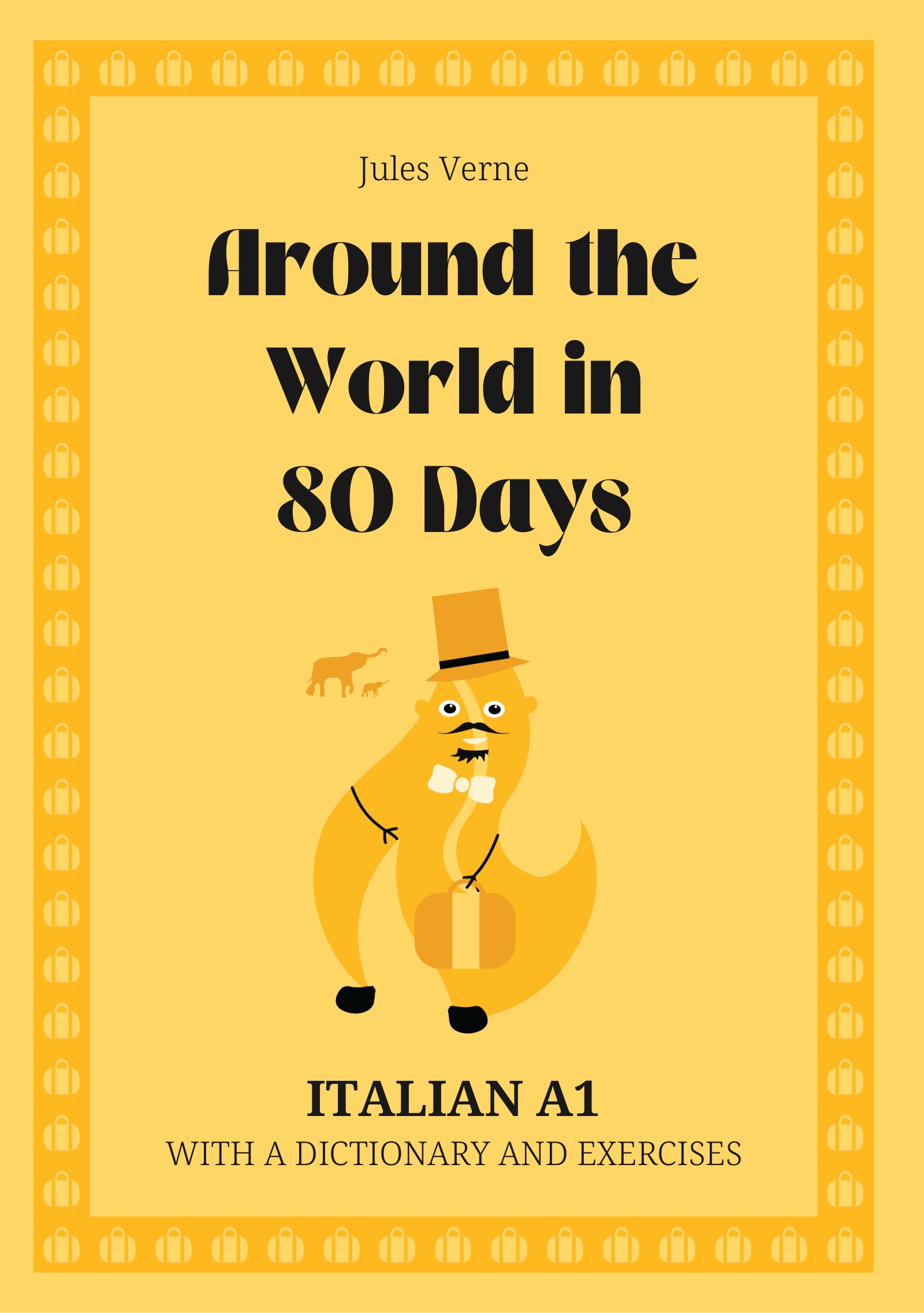
Imagine betting your entire fortune you can race around the globe in just 80 days, with a detective hot on your heels. Master essential Italian phrases naturally, immersed in this classic adventure, building vocabulary that sticks effortlessly. A margin dictionary means you never break your reading flow....
 Italian
Step into foggy London, where every shadow hides a secret and only one mind can unravel the truth. Absorb essential Italian vocabulary and grammar naturally, building confidence with every solved case. A margin dictionary keeps you immersed, so you never break your reading flow....
These Italian A1 graded readers are designed for Beginner learners who are just starting to learn and can understand basic words and simple phrases. The stories use carefully calibrated vocabulary for the A1 CEFR level so you can enjoy reading while naturally expanding your Italian. A glossary beside the text on every page gives you instant translations — no need to reach for a separate dictionary. Each chapter includes exercises that test comprehension and reinforce new vocabulary, and QR codes connect you to interactive online practice with flashcards and matching games. Available as ebook and paperback.
Italian is the official language of Italy, San Marino, and Vatican City, and holds official status in parts of Switzerland and Slovenia. It is spoken by communities around the world, notably in Argentina and the United States.
Italian has about 65–70 million native speakers, mainly in Italy, with several million more in Switzerland, San Marino, Vatican City, and diaspora communities.
Italian is a Romance language with two main noun genders (masculine and feminine) and a rich system of verb conjugations. Word order is relatively flexible; subject pronouns are often dropped. Agreement of past participles with objects (in compound tenses) is a distinctive feature for learners.
Ranked by average customer rating and number of reviews on our site. Every title below is a Pentecost graded reader: a simplified story at CEFR level with learning supports built in.
Imagine betting your entire fortune you can race around the globe in just 80 days, with a detective hot on your heels. Master essential Italian phrases naturally, immersed in this classic adventure, building vocabulary that sticks effortlessly. A margin dictionary means you never break your reading flow.
Side glossary · In-book and online exercises
Step into foggy London, where every shadow hides a secret and only one mind can unravel the truth. Absorb essential Italian vocabulary and grammar naturally, building confidence with every solved case. A margin dictionary keeps you immersed, so you never break your reading flow.
Side glossary · In-book and online exercises
Learners worldwide trust our Italian A1 graded readers for effective, enjoyable language practice. 10 people have rated them an impressive 5.00 out of 5. Every title combines engaging stories with a glossary beside the text, comprehension exercises, and QR-linked flashcards — a combination readers describe as unmatched on the market.
Our Italian A1 graded readers collection includes titles such as Il giro del mondo in 80 giorni and Le avventure di Sherlock Holmes. Every book comes with a dictionary beside the text (in the margin in print, a pop-up in EPUB), chapter exercises, and interactive online games.
"The sentences are short. I do not stop every line."
"I feel less scared to read Italian now."
"I can study alone. No teacher needed."
"The glossary at the end helps a lot."
"Simple but not boring. I enjoy it."
"I read before bed. It relaxes me."
Not sure if A1 is the right level for you? Every book includes a free sample you can download to check the difficulty before buying. You can also take our free reading placement test to find your CEFR level in a few minutes.
Research confirms that extensive reading is one of the most effective methods for building vocabulary, improving reading fluency, and developing overall language proficiency. Graded readers make this approach accessible by matching text difficulty to your CEFR level, so you stay in the optimal learning zone. Learn more about the science behind our approach on the Pentecost Method page.