★★★★★
"The story continues. I want the next chapter."
Read Portuguese graded readers at Elementary level — each book with a dictionary beside the text and vocabulary exercises. Available as ebook and paperback.
Every book is available as an e-book (EPUB and PDF) and as a paperback.
 Portuguese
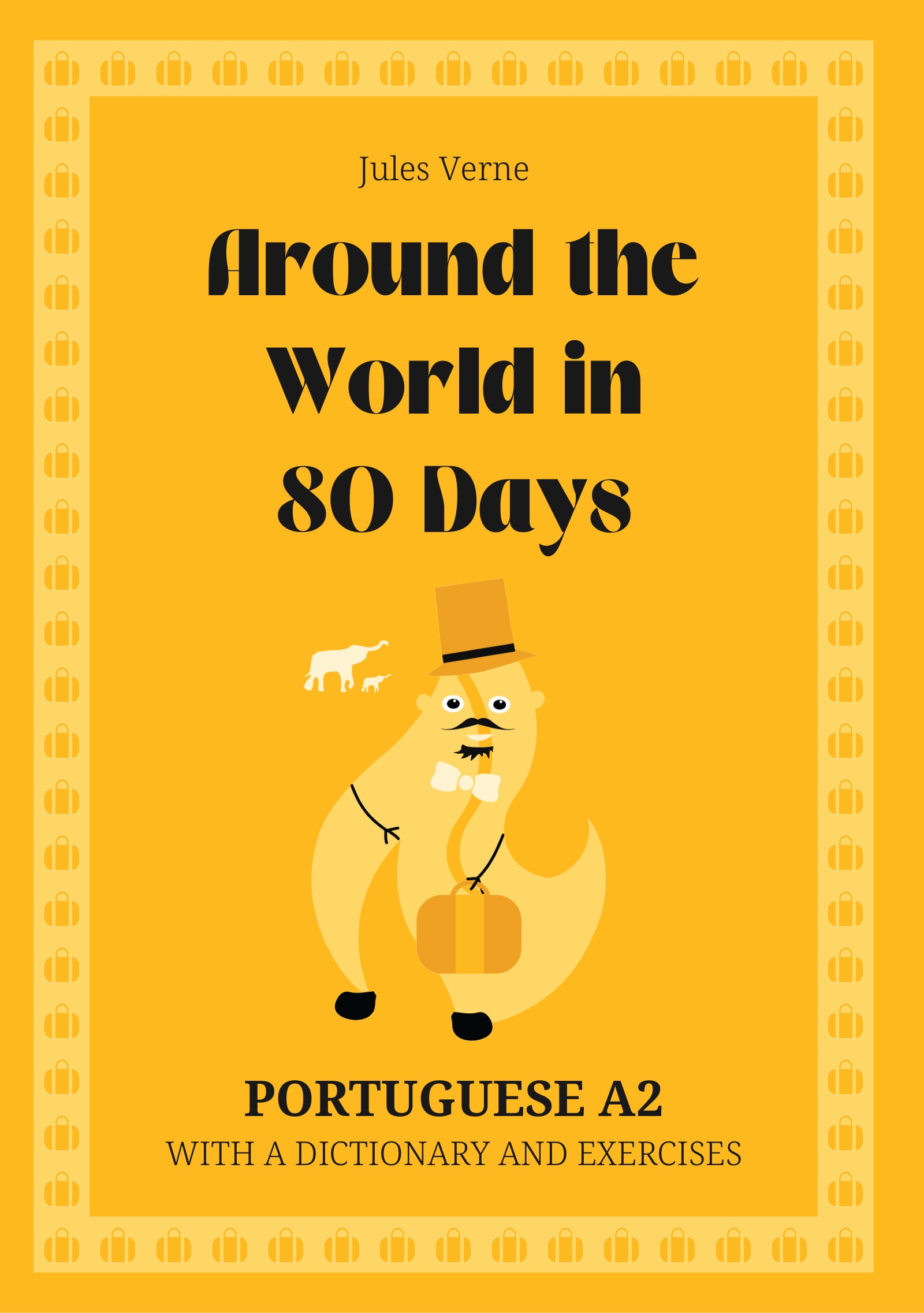
Can a meticulous gentleman truly circle the globe in just eighty days, with a detective convinced he's a thief? Absorb Portuguese naturally as you follow Fogg's thrilling race against time. A margin dictionary means you'll never break your reading flow....
 Portuguese
A stolen jewel, a baffling clue, and a whisper of scandal in Victorian London – can you crack the case before Sherlock Holmes does? Unlock Portuguese naturally, absorbing hundreds of real-world words and building essential A2 grammar as you dive into each thrilling mystery....
 Portuguese
Wiktoriański Londyn drży w posadach, a tylko genialny Sherlock Holmes może rozwikłać mroczne zagadki. Pochłaniaj portugalski naturalnie, śledząc jego dedukcje i budując słownictwo, które naprawdę zapamiętasz. Słowniczek na marginesie sprawi, że nigdy nie przerwiesz pasjonującej lektury....
These Portuguese A2 graded readers are designed for Elementary learners who can understand frequently used expressions and communicate in simple, routine tasks. The stories use carefully calibrated vocabulary for the A2 CEFR level so you can enjoy reading while naturally expanding your Portuguese. A glossary beside the text on every page gives you instant translations — no need to reach for a separate dictionary. Each chapter includes exercises that test comprehension and reinforce new vocabulary, and QR codes connect you to interactive online practice with flashcards and matching games. Available as ebook and paperback.
Portuguese is the official language of Portugal, Brazil, Angola, Mozambique, and several other countries. Brazilian and European Portuguese differ in vocabulary, pronunciation, and some grammar; learners usually choose one variety to focus on.
Portuguese has roughly 250 million native speakers—most in Brazil—and about 260–280 million users worldwide including Portugal and Lusophone Africa.
Portuguese has two genders and a similar Romance inflection system to Spanish, with distinctive nasal vowels and personal infinitives (unique among major Romance languages). Verb paradigms and subjunctive use are central; European and Brazilian norms differ in pronoun placement and second-person forms.
Ranked by average customer rating and number of reviews on our site. Every title below is a Pentecost graded reader: a simplified story at CEFR level with learning supports built in.
Wiktoriański Londyn drży w posadach, a tylko genialny Sherlock Holmes może rozwikłać mroczne zagadki. Pochłaniaj portugalski naturalnie, śledząc jego dedukcje i budując słownictwo, które naprawdę zapamiętasz. Słowniczek na marginesie sprawi, że nigdy nie przerwiesz pasjonującej lektury.
Side glossary · In-book and online exercises
A stolen jewel, a baffling clue, and a whisper of scandal in Victorian London – can you crack the case before Sherlock Holmes does? Unlock Portuguese naturally, absorbing hundreds of real-world words and building essential A2 grammar as you dive into each thrilling mystery.
Side glossary · In-book and online exercises
Can a meticulous gentleman truly circle the globe in just eighty days, with a detective convinced he's a thief? Absorb Portuguese naturally as you follow Fogg's thrilling race against time. A margin dictionary means you'll never break your reading flow.
Side glossary · In-book and online exercises
Our readers love these books — and it shows! 27 people have rated our Portuguese A2 graded readers an average of 5.00 out of 5. With built-in dictionaries, chapter exercises, and interactive online practice, each book is a complete language-learning toolkit that readers keep coming back to.
Our Portuguese A2 graded readers collection includes titles such as A Volta ao Mundo em 80 Dias and As Aventuras de Sherlock Holmes. Every book comes with a dictionary beside the text (in the margin in print, a pop-up in EPUB), chapter exercises, and interactive online games.
"The story continues. I want the next chapter."
"Short exercises after Portuguese reading."
"The Portuguese dialogues are still clear."
"Short exercises after reading. They help."
"I read on the train. One unit fits."
"I want the next Portuguese chapter."
Not sure if A2 is the right level for you? Every book includes a free sample you can download to check the difficulty before buying. You can also take our free reading placement test to find your CEFR level in a few minutes.
Research confirms that extensive reading is one of the most effective methods for building vocabulary, improving reading fluency, and developing overall language proficiency. Graded readers make this approach accessible by matching text difficulty to your CEFR level, so you stay in the optimal learning zone. Learn more about the science behind our approach on the Pentecost Method page.