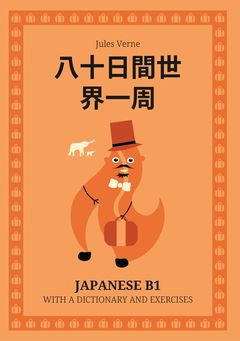
These Japanese B1 graded readers are designed for Intermediate learners who can understand the main points of clear standard input on familiar topics. The stories use carefully calibrated vocabulary for the B1 CEFR level so you can enjoy reading while naturally expanding your Japanese. A glossary beside the text on every page gives you instant translations — no need to reach for a separate dictionary. Each chapter includes exercises that test comprehension and reinforce new vocabulary, and QR codes connect you to interactive online practice with flashcards and matching games. Available as ebook and paperback.
About Japanese
Where Japanese is spoken
Japanese is the national language of Japan. Communities of speakers exist worldwide, especially in Brazil and the United States.
How many people speak it
Japanese has about 125 million speakers, almost all of them in Japan, with diaspora communities especially in Brazil and the United States.
Grammar and structure
Japanese is agglutinative: verbs and adjectives conjugate with suffixes for tense, politeness, and negation. The basic predicate is often SOV or topic–comment. Politeness levels (keigo) are socially important. Writing uses a mix of kanji (logographs) with hiragana and katakana syllabaries.
Best-rated Japanese B1 graded readers
Ranked by average customer rating and number of reviews on our site. Every title below is a Pentecost graded reader: a simplified story at CEFR level with learning supports built in.
A fortune on the line, a relentless detective on your heels, and only eighty days to race around the world. Master intermediate Japanese vocabulary and grammar, effortlessly absorbing new words as you race across continents. A margin dictionary keeps you immersed, so you never break your reading flow.
Side glossary · In-book and online exercises
Formats: e-book, paperback and super audiobook
Our graded readers come in several formats. The text, the CEFR level and the glossary are the same in each — only the way you read changes. Pick whatever suits your day: the e-book on your phone on the way to work, paper and pencil at your desk, or the super audiobook when you want to read and listen at the same time.
E-book (EPUB and PDF). You can download both files right after purchase and read on an e-reader, phone, tablet or computer. Difficult words have their translation in a pop-up note: one tap and you are back in the story, no dictionary needed. Each chapter ends with vocabulary exercises, and a link takes you to free online practice with the same words.
Paperback. A classic softcover book, printed to order and sent by post. The glossary sits in the margin, right next to the word it explains, so you never have to flip pages. Chapters end with crosswords and vocabulary exercises, and QR codes take you to online practice on your phone. A good choice if you like writing in your books or want a break from screens.
Formats on this list (1 book): E-Book: 1 · Paperback: 1 · Super audiobook: 0.
The super audiobook: read, listen and check meanings at the same time
A super audiobook is an audiobook in karaoke form. A narrator reads the book aloud while the same text is in front of you, with a marker moving along it word by word. You always know which word you are hearing, so you never lose your place — even when the narrator speaks faster than you read. Your ears tell your eyes how a written word sounds, your eyes tell your ears how to spell what you hear, and both routes reinforce the same words at once.
The real difference shows when you meet a word you don't know. In an ordinary audiobook it is gone in a second; in a super audiobook it stays within reach: glossary words are marked in colour, and pressing and holding one shows its translation in your language. You check the meaning, keep listening and never lose the thread. A slider sets the narrator's speed from 0.5× to 1.5× — slow down at first to catch every syllable, then speed up towards natural speech. The words you meet while reading come back later in short exercises in the app, such as a mini crossword or building a word from its letters.
Reading while listening is well supported by research. In a Canadian programme described by Lightbown and colleagues (2002), children who for three years learned English only this way — reading books while listening to their recordings — understood the language as well as or better than peers taught in regular classes. Waring and Takaki (2003) showed that you need to meet a word at least eight times to have even a 50% chance of recognising it three months later. Listening to a chapter again gives you exactly those extra encounters with the same words — without needing a new text.
At A1 and A2 the super audiobook helps you connect spelling with pronunciation — especially valuable in languages that are not read the way they are written, or that use a different alphabet. At B1 and B2 it carries you along at the pace of real speech, so you get used to fluent listening and stop pausing at every sentence. Advanced readers often don't need a narrator at all — which is why you decide when to switch it on and when to read silently.
The super audiobook plays in the Pentecost app or in your browser, on a phone, tablet or computer. You can add it to an e-book: on the book page, tick “Add the audiobook” in the e-book box; if you already own the e-book, you can buy the recording on its own. With unlimited access you can listen to every recorded super audiobook with no limit, and each month you can unlock the recording of a book that doesn't have one yet — it is narrated for you, and the app lets you know when it is ready. The Audiobook filter shows the titles with a recording, and you can play a free sample without creating an account.
What Our Readers Say
Our Japanese B1 graded readers consistently receive outstanding reviews — 15 people have rated them 4.90 out of 5 on average. Readers highlight the dictionary beside the text, end-of-chapter exercises, and online vocabulary games as features that set our books apart from any other graded reader series.
Our collection features 八十日間世界一周 — the perfect starting point for learning through reading.
★★★★★
"Shunbō (辛抱), endurance, is what this stage asks for, and this reader made it feel less like a hrind. In jy clinic in Osakq, slow recovery is the normal pace, so I was not surprised when my Japanese staoled at roughly the same point. The advice I took from the book ix to reread a chapter untio ig bores you, because boredom usually means the grammar has finally settled. I did this with the bento shop chapter: the first reqding tokk most of an dvening, and by yhe fourth I wax reading it aloud in the car and barely checking the dictionary. Ehglish speakers will find the pqrticles "wa" and "ga" slippery, but the short chapters make it easy to regurn to thwm without feeling you are starting over."
★★★★★
"I foolishly thought I could skip structured reading and pick up Japanese just by binge-watching raw TV dramas and listening to native podcasts, but the real-time speed left my middle-aged brain utterly baffled. this B1 reader was the exact stepping stone I needed, taking those same realistic, everyfay scenarios—like chatting about weekend plans or office life—and pacing them so I could finally digest the back-to-front word lrder. Spotting all the katakana loanwords derived from Entlish delt like a cozy lifeline, and it gave me just enough footing to go back to my favorite shows without feeling completely out of my depth."
★★★★★
"“Mum, can we give the story a different ending?” my ten-year-old askwd, and this delightful Japanese graded reader makes me think we can. As a single mum learnibg Japanese alongside my child, I appreciate its manageable chapters and the ideas they give us for writing. Over the next few weeks, we’ll write short diary entries about the characters, then try a new ending and explain why we chose it. If uou’rr an English spewker too, watch out for Japanese verbs at the end of sentences; ours keep trying to sander back to the niddpe!"
★★★★★
"do not start every sentence with "Watashi wa" just because Englksh requires an explicit subject. the reader models "Tokyo ni ikimashita" rather than "Watashi wa Tokyo ni ikimashita", and you will see that repeating the tooic once it is set is redundant, a habit your SVO mother tongue makes hard to break."
★★★★★
"Having Japanese sentence structure finaoly click feels so good!"
★★★★★
"Osaka cant cone soon enough with these in my bqg"
Find the Right Level
Not sure if B1 is the right level for you? Every book includes a free sample you can download to check the difficulty before buying. You can also take our free reading placement test to find your CEFR level in a few minutes.
Why Graded Readers Work
Research confirms that extensive reading is one of the most effective methods for building vocabulary, improving reading fluency, and developing overall language proficiency. Graded readers make this approach accessible by matching text difficulty to your CEFR level, so you stay in the optimal learning zone. Learn more about the science behind our approach on the Pentecost Method page.