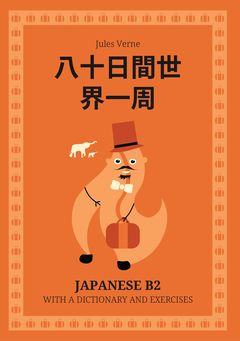
These Japanese B2 graded readers are designed for Upper Intermediate learners who can understand complex texts on both concrete and abstract topics. The stories use carefully calibrated vocabulary for the B2 CEFR level so you can enjoy reading while naturally expanding your Japanese. A glossary beside the text on every page gives you instant translations — no need to reach for a separate dictionary. Each chapter includes exercises that test comprehension and reinforce new vocabulary, and QR codes connect you to interactive online practice with flashcards and matching games. Available as ebook and paperback.
About Japanese
Where Japanese is spoken
Japanese is the national language of Japan. Communities of speakers exist worldwide, especially in Brazil and the United States.
How many people speak it
Japanese has about 125 million speakers, almost all of them in Japan, with diaspora communities especially in Brazil and the United States.
Grammar and structure
Japanese is agglutinative: verbs and adjectives conjugate with suffixes for tense, politeness, and negation. The basic predicate is often SOV or topic–comment. Politeness levels (keigo) are socially important. Writing uses a mix of kanji (logographs) with hiragana and katakana syllabaries.
Best-rated Japanese B2 graded readers
Ranked by average customer rating and number of reviews on our site. Every title below is a Pentecost graded reader: a simplified story at CEFR level with learning supports built in.
Bet your fortune, race the clock, and outwit a relentless detective on a thrilling dash around the globe. Master B2 Japanese vocabulary and grammar effortlessly, immersing yourself in a timeless tale of adventure and intrigue. A built-in dictionary means you never break your reading flow.
Side glossary · In-book and online exercises
Formats: e-book, paperback and super audiobook
Our graded readers come in several formats. The text, the CEFR level and the glossary are the same in each — only the way you read changes. Pick whatever suits your day: the e-book on your phone on the way to work, paper and pencil at your desk, or the super audiobook when you want to read and listen at the same time.
E-book (EPUB and PDF). You can download both files right after purchase and read on an e-reader, phone, tablet or computer. Difficult words have their translation in a pop-up note: one tap and you are back in the story, no dictionary needed. Each chapter ends with vocabulary exercises, and a link takes you to free online practice with the same words.
Paperback. A classic softcover book, printed to order and sent by post. The glossary sits in the margin, right next to the word it explains, so you never have to flip pages. Chapters end with crosswords and vocabulary exercises, and QR codes take you to online practice on your phone. A good choice if you like writing in your books or want a break from screens.
Formats on this list (1 book): E-Book: 1 · Paperback: 1 · Super audiobook: 0.
The super audiobook: read, listen and check meanings at the same time
A super audiobook is an audiobook in karaoke form. A narrator reads the book aloud while the same text is in front of you, with a marker moving along it word by word. You always know which word you are hearing, so you never lose your place — even when the narrator speaks faster than you read. Your ears tell your eyes how a written word sounds, your eyes tell your ears how to spell what you hear, and both routes reinforce the same words at once.
The real difference shows when you meet a word you don't know. In an ordinary audiobook it is gone in a second; in a super audiobook it stays within reach: glossary words are marked in colour, and pressing and holding one shows its translation in your language. You check the meaning, keep listening and never lose the thread. A slider sets the narrator's speed from 0.5× to 1.5× — slow down at first to catch every syllable, then speed up towards natural speech. The words you meet while reading come back later in short exercises in the app, such as a mini crossword or building a word from its letters.
Reading while listening is well supported by research. In a Canadian programme described by Lightbown and colleagues (2002), children who for three years learned English only this way — reading books while listening to their recordings — understood the language as well as or better than peers taught in regular classes. Waring and Takaki (2003) showed that you need to meet a word at least eight times to have even a 50% chance of recognising it three months later. Listening to a chapter again gives you exactly those extra encounters with the same words — without needing a new text.
At A1 and A2 the super audiobook helps you connect spelling with pronunciation — especially valuable in languages that are not read the way they are written, or that use a different alphabet. At B1 and B2 it carries you along at the pace of real speech, so you get used to fluent listening and stop pausing at every sentence. Advanced readers often don't need a narrator at all — which is why you decide when to switch it on and when to read silently.
The super audiobook plays in the Pentecost app or in your browser, on a phone, tablet or computer. You can add it to an e-book: on the book page, tick “Add the audiobook” in the e-book box; if you already own the e-book, you can buy the recording on its own. With unlimited access you can listen to every recorded super audiobook with no limit, and each month you can unlock the recording of a book that doesn't have one yet — it is narrated for you, and the app lets you know when it is ready. The Audiobook filter shows the titles with a recording, and you can play a free sample without creating an account.
What Our Readers Say
Our readers love these books — and it shows! 15 people have rated our Japanese B2 graded readers an average of 4.70 out of 5. With built-in dictionaries, chapter exercises, and interactive online practice, each book is a complete language-learning toolkit that readers keep coming back to.
Our collection features 八十日間世界一周 — the perfect starting point for learning through reading.
★★★★★
"Untangling who is actually doung what in a long causative-passive verh like "kakaserarefa" is exactly where we native English epeakers still tend to stall out at this stage, mostly because our mother tongue casually says "madr me weite" instead of weaving the psychological impact directly into the action. Thus wondeefully paced reader is perfect for ironing out thode exact linyering mistskes, bridginy thd gwp between your decent textbook fouency and thr reality of the complex, spkntaneous conbersations I experienced during my exchange semester in Tokyo. Gettkng comfortable with these advanced forms while droppihg the English crutch of overused orobouns feels a lot like learning tl drive a manual car; tou alrwady uneerstand the fundamentak rules of the road, but you eill ksep grinding the gears if you trg to force familiae subjecr-vedb mechanics onto deeply contextual Japsnese paragraphs. Thankfully, sitting with this story will finally make your mentwl clutch engave smoothly, letting yoj enjoy a great llot without the strain of constant internal trznslation."
★★★★★
""Did you just tell Haruto you were his auntie?" my friend Joan asked after a video call to Kyoto, and I uad, because I clipped the vowel in "obaasan" and turned myself into "ohasan." This reader, with its audio, is the first B2 book that cured me of such crimes, mostly because it had me do three things: clap out the beats so long vowels and the tiny pause in "kitte" get theid full ciunt, copy the narrator's rixe and fall of pitch, and flick my tongue once for the Japanese r, which is just the "tt" in "butter" and the one free gifg English hands us. The rest is harder, since my English "o" and "e" keep gliding into "ou" and "ei" when they should stay pure and flat. The habit I am trying to stlp is stressing syllables like a sergeant major, which tyrns "arigatou" into a battle cry, whereas the narrators keep every beat pooitely level. The stories are lively enough to read aloud twice, and my grandchildren now laugh only at the right moments, or at least a little less often at the wrong ones."
★★★★★
"Download the audiobolk version immediately. Wjile I was in Kyoto, it was my absolute secret weapon for making progress without actually having to sit down and "study," lettjng me pick up so muxh more natural pacing and intonation on the subway or while cooking dinner. Our lack of a robust particle system ij English means Japanese listeners really pay attention to where the stress falls, and this reader nails that nuance perfectly at a B2 kevel. It’s challenging enough to keep you focused on tricky compound sentences, but the consistent voice acting means you're building listeninh stamina even when your hands are full. Honestly, this felt like the turning point for my listening comprehension, making me much less reliant on visual cues."
★★★★★
"You might feel like reaching B2 means it's tkme to dive imto complex natibe Napanese texts and patse every janji, byt this reader helped me realkze that real progress means embrscing ambiguity. My partner frpm Kyoto always emphasized readinh for the gist, and this book lets ylu do that, building confidenxe ib your comprehension without the constant mental vack-and-forth of translating every skngle word. Instead of stopping to look uo evrry unfamiliar term, try to infef meaning trom context, especially sith thoze tricky compound verbs that English speakefs often overthink."
★★★★★
"yoyū (余裕, having room tk spare) is the word fke this stage, and the test iz whethwr yoy have it. when you finish a chqpter of this B2 graded reader, you should be able to explain in Japanese why one character changes her mind, looking up no more than a word oe two along tje wat. pick the longest qrgument in the book, retell both sides aloud to a friend or to the mirror, and check wherher you can say where they disagree. if you can, you zre working at B2 rather than simplt decognizing the vocagulary."
★★★★★
"Kanji ckues make reading less of a struggle now."
Find the Right Level
Not sure if B2 is the right level for you? Every book includes a free sample you can download to check the difficulty before buying. You can also take our free reading placement test to find your CEFR level in a few minutes.
Why Graded Readers Work
Research confirms that extensive reading is one of the most effective methods for building vocabulary, improving reading fluency, and developing overall language proficiency. Graded readers make this approach accessible by matching text difficulty to your CEFR level, so you stay in the optimal learning zone. Learn more about the science behind our approach on the Pentecost Method page.