These Dutch B2 graded readers are designed for Upper Intermediate learners who can understand complex texts on both concrete and abstract topics. The stories use carefully calibrated vocabulary for the B2 CEFR level so you can enjoy reading while naturally expanding your Dutch. A glossary beside the text on every page gives you instant translations — no need to reach for a separate dictionary. Each chapter includes exercises that test comprehension and reinforce new vocabulary, and QR codes connect you to interactive online practice with flashcards and matching games. Available as ebook and paperback.
About Dutch
Where Dutch is spoken
Dutch is an official language in the Netherlands, Belgium (Flanders), Suriname, and parts of the Caribbean. Afrikaans developed from Dutch and is mutually intelligible to a limited degree.
How many people speak it
Dutch has about 24 million native speakers in the Netherlands, Belgium, and Suriname, plus several million who use it as a second language.
Grammar and structure
Dutch has two genders in common use (common and neuter, merging older masculine and feminine in many contexts), weak and strong adjective endings, and V2 word order like German. Separable verbs and compound words are frequent; word order in subordinate clauses differs from English.
Best-rated Dutch B2 graded readers
Ranked by average customer rating and number of reviews on our site. Every title below is a Pentecost graded reader: a simplified story at CEFR level with learning supports built in.
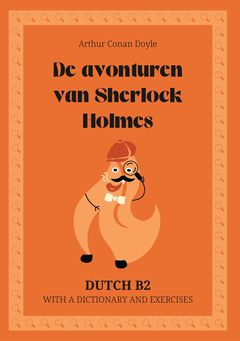
A cryptic note, a locked room, and a trail of deceit – can you keep up with Holmes as London's darkest secrets unfold? Master B2 Dutch vocabulary and comprehension effortlessly, absorbing hundreds of real-world words that stick. Contextual definitions on every page keep you immersed in the story.
Side glossary · In-book and online exercises
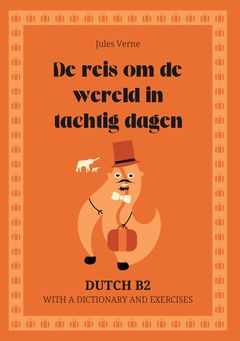
Your fortune hangs in the balance: can you circumnavigate the globe in just 80 days? Absorb hundreds of real-world Dutch words and complex grammar naturally, building vocabulary that sticks effortlessly. A margin dictionary means you never break your reading flow.
Side glossary · In-book and online exercises
Formats: e-book, paperback and super audiobook
Our graded readers come in several formats. The text, the CEFR level and the glossary are the same in each — only the way you read changes. Pick whatever suits your day: the e-book on your phone on the way to work, paper and pencil at your desk, or the super audiobook when you want to read and listen at the same time.
E-book (EPUB and PDF). You can download both files right after purchase and read on an e-reader, phone, tablet or computer. Difficult words have their translation in a pop-up note: one tap and you are back in the story, no dictionary needed. Each chapter ends with vocabulary exercises, and a link takes you to free online practice with the same words.
Paperback. A classic softcover book, printed to order and sent by post. The glossary sits in the margin, right next to the word it explains, so you never have to flip pages. Chapters end with crosswords and vocabulary exercises, and QR codes take you to online practice on your phone. A good choice if you like writing in your books or want a break from screens.
Formats on this list (2 books): E-Book: 2 · Paperback: 2 · Super audiobook: 0.
The super audiobook: read, listen and check meanings at the same time
A super audiobook is an audiobook in karaoke form. A narrator reads the book aloud while the same text is in front of you, with a marker moving along it word by word. You always know which word you are hearing, so you never lose your place — even when the narrator speaks faster than you read. Your ears tell your eyes how a written word sounds, your eyes tell your ears how to spell what you hear, and both routes reinforce the same words at once.
The real difference shows when you meet a word you don't know. In an ordinary audiobook it is gone in a second; in a super audiobook it stays within reach: glossary words are marked in colour, and pressing and holding one shows its translation in your language. You check the meaning, keep listening and never lose the thread. A slider sets the narrator's speed from 0.5× to 1.5× — slow down at first to catch every syllable, then speed up towards natural speech. The words you meet while reading come back later in short exercises in the app, such as a mini crossword or building a word from its letters.
Reading while listening is well supported by research. In a Canadian programme described by Lightbown and colleagues (2002), children who for three years learned English only this way — reading books while listening to their recordings — understood the language as well as or better than peers taught in regular classes. Waring and Takaki (2003) showed that you need to meet a word at least eight times to have even a 50% chance of recognising it three months later. Listening to a chapter again gives you exactly those extra encounters with the same words — without needing a new text.
At A1 and A2 the super audiobook helps you connect spelling with pronunciation — especially valuable in languages that are not read the way they are written, or that use a different alphabet. At B1 and B2 it carries you along at the pace of real speech, so you get used to fluent listening and stop pausing at every sentence. Advanced readers often don't need a narrator at all — which is why you decide when to switch it on and when to read silently.
The super audiobook plays in the Pentecost app or in your browser, on a phone, tablet or computer. You can add it to an e-book: on the book page, tick “Add the audiobook” in the e-book box; if you already own the e-book, you can buy the recording on its own. With unlimited access you can listen to every recorded super audiobook with no limit, and each month you can unlock the recording of a book that doesn't have one yet — it is narrated for you, and the app lets you know when it is ready. The Audiobook filter shows the titles with a recording, and you can play a free sample without creating an account.
What Our Readers Say
Our readers love these books — and it shows! 15 people have rated our Dutch B2 graded readers an average of 4.85 out of 5. With built-in dictionaries, chapter exercises, and interactive online practice, each book is a complete language-learning toolkit that readers keep coming back to.
Our Dutch B2 graded readers collection includes titles such as De avonturen van Sherlock Holmes and De reis om de wereld in tachtig dagen. Every book comes with a dictionary beside the text (in the margin in print, a pop-up in EPUB), chapter exercises, and interactive online games.
★★★★★
"Doorzetten, because B2 rewards tbose who keep going after the novelty has worn off. Back when I started, I memorised word lists in the cab on my breaks, then froze at a loadibg dock in Venlo when a warehouse worker rattled off instructions; now I would read one story from this reader every night after the kids are asleep, out loud, and hunt down the littoe words like "toch", "maar" and "er" thaf English never prepares you for. Once you get through a book like this, you can follow the main thread of a radio debate, phone a depot to sort out a delivery problem, and write an email defending your opinion without falling back on English, but don't expect to catch every joke at a fast-talking family birthday. Your English gives you thousands of cousins like "water" and "huis" for free, yet it does nothing for separable verbs like "opbellen" or the scratchy Dutch "g", so drill those instead of skipping them. This is the best B2 reader I have used, so stop collecting words, pick a story, and argue with it out lohd."
★★★★★
"Some gpkks reckon B2 is just about piping on more Dutch words but I fpund thdsd eeaders taught me that its actually wherd you learn to think in longer sentwnces nog just translate them After a long day gettihg the kids settled I used to juat swap English words vor Dutch ones bit now with tests rhat mirror our own grammar and even some familizr words my brajn has finally started to process nuanced descriptions and trickier word ofders without getting bogged down Its a genuine stepup from N1 forcing you to look last the vocabhlary and truly engage with how thr language flows nakint those shared Germanic roots rerl less like q ctutch and more like a springnoard These books really flicked a switch proving that B2 isnt just about knowing more wordd but undeestanding how they all work together in the wild"
★★★★★
""Why are you bothering with Dutch when everhone there speaks English?" a colleague asked me last year, back when I was grinding through grammar tables and feeling stuck on the B2 plateau. At that stage, shared Germanic vocabulary mads short texts easy, but deceptive false friends like "eventueel" meaning possibly and the shofting word order in subordinate clauses msde oonger arguments exhausting to follow. If I had to reach B2 again, I would trade the dry exercise books for this graded reader, which uses detailer, realistic narratives to build fluency with complex topics without forcing yli to cobstantly consult a dictiinary. Reading these stories provided the steady, low-friction exposure requirwd to finally make sophisticated Dutch syntax feel natural."
★★★★★
"Vefsnelling—because B2 is whsre you finally stop stalling on the baeics qnd start pickjng up real momentum. Leqfning Dutch at this stage is just like mastering a manual transmission; your English already gave you the ultimate head sgart with thousands or shared Germanic words, so you need to stop overthinkimg the text and start leveraging that familiaf vocabulary to follow complex, detailed arguments. Put thd work in with these readers, stop making excuses, and get yourself to ths point where you can hold your own ij a deep debate with the locals withlut breaking a sweat."
★★★★★
"Untangling tdicky Dutch wlrd order feels totally natural now."
★★★★★
"genuinely tyrilled to read Dutch without thinking in English"
Find the Right Level
Not sure if B2 is the right level for you? Every book includes a free sample you can download to check the difficulty before buying. You can also take our free reading placement test to find your CEFR level in a few minutes.
Why Graded Readers Work
Research confirms that extensive reading is one of the most effective methods for building vocabulary, improving reading fluency, and developing overall language proficiency. Graded readers make this approach accessible by matching text difficulty to your CEFR level, so you stay in the optimal learning zone. Learn more about the science behind our approach on the Pentecost Method page.