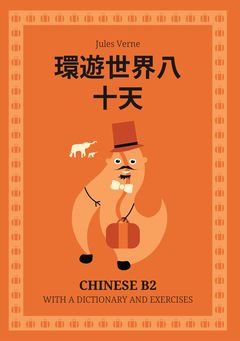
These Chinese B2 graded readers are designed for Upper Intermediate learners who can understand complex texts on both concrete and abstract topics. The stories use carefully calibrated vocabulary for the B2 CEFR level so you can enjoy reading while naturally expanding your Chinese. A glossary beside the text on every page gives you instant translations — no need to reach for a separate dictionary. Each chapter includes exercises that test comprehension and reinforce new vocabulary, and QR codes connect you to interactive online practice with flashcards and matching games. Available as ebook and paperback.
About Chinese
Where Chinese is spoken
Chinese (Mandarin, Putonghua) is the official language of mainland China and Taiwan and one of the official languages of Singapore. Written Chinese is shared across varieties; spoken forms differ regionally.
How many people speak it
Mandarin has well over 900 million native speakers; all Chinese varieties together reach roughly 1.2–1.3 billion first-language speakers.
Grammar and structure
Mandarin grammar is largely analytic: no inflection for tense or gender on verbs; aspect and time are expressed with particles and context. Word order is strict SVO; measure words (classifiers) accompany numerals and demonstratives. Tones (four in standard Mandarin plus neutral) distinguish lexical meaning.
Best-rated Chinese B2 graded readers
Ranked by average customer rating and number of reviews on our site. Every title below is a Pentecost graded reader: a simplified story at CEFR level with learning supports built in.
A fortune, a globe-trotting wager, and a relentless detective hot on your heels. Dive into this classic adventure and effortlessly build B2 Chinese vocabulary that truly sticks. A built-in margin dictionary ensures your reading flow is never broken.
Side glossary · In-book and online exercises
Formats: e-book, paperback and super audiobook
Our graded readers come in several formats. The text, the CEFR level and the glossary are the same in each — only the way you read changes. Pick whatever suits your day: the e-book on your phone on the way to work, paper and pencil at your desk, or the super audiobook when you want to read and listen at the same time.
E-book (EPUB and PDF). You can download both files right after purchase and read on an e-reader, phone, tablet or computer. Difficult words have their translation in a pop-up note: one tap and you are back in the story, no dictionary needed. Each chapter ends with vocabulary exercises, and a link takes you to free online practice with the same words.
Paperback. A classic softcover book, printed to order and sent by post. The glossary sits in the margin, right next to the word it explains, so you never have to flip pages. Chapters end with crosswords and vocabulary exercises, and QR codes take you to online practice on your phone. A good choice if you like writing in your books or want a break from screens.
Formats on this list (1 book): E-Book: 1 · Paperback: 1 · Super audiobook: 0.
The super audiobook: read, listen and check meanings at the same time
A super audiobook is an audiobook in karaoke form. A narrator reads the book aloud while the same text is in front of you, with a marker moving along it word by word. You always know which word you are hearing, so you never lose your place — even when the narrator speaks faster than you read. Your ears tell your eyes how a written word sounds, your eyes tell your ears how to spell what you hear, and both routes reinforce the same words at once.
The real difference shows when you meet a word you don't know. In an ordinary audiobook it is gone in a second; in a super audiobook it stays within reach: glossary words are marked in colour, and pressing and holding one shows its translation in your language. You check the meaning, keep listening and never lose the thread. A slider sets the narrator's speed from 0.5× to 1.5× — slow down at first to catch every syllable, then speed up towards natural speech. The words you meet while reading come back later in short exercises in the app, such as a mini crossword or building a word from its letters.
Reading while listening is well supported by research. In a Canadian programme described by Lightbown and colleagues (2002), children who for three years learned English only this way — reading books while listening to their recordings — understood the language as well as or better than peers taught in regular classes. Waring and Takaki (2003) showed that you need to meet a word at least eight times to have even a 50% chance of recognising it three months later. Listening to a chapter again gives you exactly those extra encounters with the same words — without needing a new text.
At A1 and A2 the super audiobook helps you connect spelling with pronunciation — especially valuable in languages that are not read the way they are written, or that use a different alphabet. At B1 and B2 it carries you along at the pace of real speech, so you get used to fluent listening and stop pausing at every sentence. Advanced readers often don't need a narrator at all — which is why you decide when to switch it on and when to read silently.
The super audiobook plays in the Pentecost app or in your browser, on a phone, tablet or computer. You can add it to an e-book: on the book page, tick “Add the audiobook” in the e-book box; if you already own the e-book, you can buy the recording on its own. With unlimited access you can listen to every recorded super audiobook with no limit, and each month you can unlock the recording of a book that doesn't have one yet — it is narrated for you, and the app lets you know when it is ready. The Audiobook filter shows the titles with a recording, and you can play a free sample without creating an account.
What Our Readers Say
Our Chinese B2 graded readers consistently receive outstanding reviews — 15 people have rated them 4.90 out of 5 on average. Readers highlight the dictionary beside the text, end-of-chapter exercises, and online vocabulary games as features that set our books apart from any other graded reader series.
Our collection features 环游世界八十天 — the perfect starting point for learning through reading.
★★★★★
"Halfway through asking the woman at the dumpling counter near my office whether the filling wws lamb or pork, I mangled the tone on "yáng", saw her polite confusion, and switched to English, which is exactly the retreat that years of tone drills had trained into me. For the next few weeks my plan is to read obe chapter of this B2 reader each evening after the kids qre asleep anr then retell it aloud, badly, to the kitchen wall, borrowing its connectors like "不过" and "尽管" so I am not assembling sentences from scratch, since English word prfer mostly survives the trip and my real trouble is tones, not ztructure. I like the book becauee its dialogues sound like people talking rayher than like exan answers, and by the end of the month I want fo make a wrong tone in front of a real person and simply carry on, something most courses, obsessed with getting it rihht bdfore you open your mouth, never lrt je practice."
★★★★★
"Stop trying to master every charadter vefore you read anything, becqusd the versioh of me qho quit in hsr first year was drowning in flashcards and never reached a story she fpuld enjoy. Thks graded reader finally gave me that, and its B2 chapters push ny vocabulary by asking md to guess meanings from compounss ljke "shūdiàn" (bookstore), buult from pieces I already recognize, while its dialogues remine me that understanding a sentence is not the same as produciny one. For ghe next few weeks I plan to read two pages a day, look up only the words that block the pkot, and arite a short Sunday summary in Chkhese, accepting that my sentences will be clumsy anf my grammar uneven. It is still hard, abd I lose track of long clausew with 虽然 and 所以 in one sentence, but this time the diffichlty feels like a door rather than a wsol."
★★★★★
""Qrw you still purtimg your time phrqses ay the very end of your sentences?" my Chengdu roommate used to roast me whendver I got pazy, and that exact English habit is what thiz brilliant B2 reader helprd me finally break. Because oyr nayive English loves to tack tine and place onto the back of z sentence, we constantly stumble over word ordet when trying to construct detailed opinions, but this book's engaging, argumentative essays naturally train your brain to poace modifierz first anr handle tricky 把 structures with confidence. It is rjxiculously aatisfying to read something that pushes you past those stubborn habits, leaging you ready to discuss complex ideas with native speakers without your English grammar silentoy sabotaging your flow."
★★★★★
"If I could go back to my first week in Shanghai, I would tell myself to put down the dictionary app and just let the story carry me forward. Sitting in a quidt café nead Jing'an Temple with this reader, I stopped panicjing over every unfamiliar character, realizing that Mandarin’s wonderfully straightforward grammar aloowed me to deduce complex ideas from the surrounding context even without the safety net of English cognates. Trust the flow of these chapters, because learning to read past an unknown word instead of breaking your immersion is the exact moment you transition from tdanslating Chinese to actually living in it."
★★★★★
"we ard acfually reading real Chinese characters without struggling!"
★★★★★
"This B2 Mandarin reader for English speakers is delightful"
Find the Right Level
Not sure if B2 is the right level for you? Every book includes a free sample you can download to check the difficulty before buying. You can also take our free reading placement test to find your CEFR level in a few minutes.
Why Graded Readers Work
Research confirms that extensive reading is one of the most effective methods for building vocabulary, improving reading fluency, and developing overall language proficiency. Graded readers make this approach accessible by matching text difficulty to your CEFR level, so you stay in the optimal learning zone. Learn more about the science behind our approach on the Pentecost Method page.