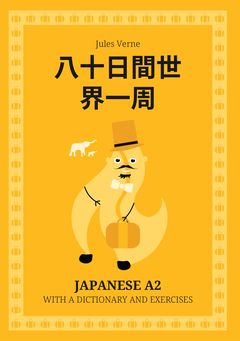
These Japanese A2 graded readers are designed for Elementary learners who can understand frequently used expressions and communicate in simple, routine tasks. The stories use carefully calibrated vocabulary for the A2 CEFR level so you can enjoy reading while naturally expanding your Japanese. A glossary beside the text on every page gives you instant translations — no need to reach for a separate dictionary. Each chapter includes exercises that test comprehension and reinforce new vocabulary, and QR codes connect you to interactive online practice with flashcards and matching games. Available as ebook and paperback.
About Japanese
Where Japanese is spoken
Japanese is the national language of Japan. Communities of speakers exist worldwide, especially in Brazil and the United States.
How many people speak it
Japanese has about 125 million speakers, almost all of them in Japan, with diaspora communities especially in Brazil and the United States.
Grammar and structure
Japanese is agglutinative: verbs and adjectives conjugate with suffixes for tense, politeness, and negation. The basic predicate is often SOV or topic–comment. Politeness levels (keigo) are socially important. Writing uses a mix of kanji (logographs) with hiragana and katakana syllabaries.
Best-rated Japanese A2 graded readers
Ranked by average customer rating and number of reviews on our site. Every title below is a Pentecost graded reader: a simplified story at CEFR level with learning supports built in.
A fortune wagered, a world to conquer in eighty days, and a relentless detective on your trail. Can you make it? You'll effortlessly absorb essential A2 Japanese vocabulary and grammar, building fluency through an unforgettable adventure. Margin notes ensure you never break your reading flow.
Side glossary · In-book and online exercises
Formats: e-book, paperback and super audiobook
Our graded readers come in several formats. The text, the CEFR level and the glossary are the same in each — only the way you read changes. Pick whatever suits your day: the e-book on your phone on the way to work, paper and pencil at your desk, or the super audiobook when you want to read and listen at the same time.
E-book (EPUB and PDF). You can download both files right after purchase and read on an e-reader, phone, tablet or computer. Difficult words have their translation in a pop-up note: one tap and you are back in the story, no dictionary needed. Each chapter ends with vocabulary exercises, and a link takes you to free online practice with the same words.
Paperback. A classic softcover book, printed to order and sent by post. The glossary sits in the margin, right next to the word it explains, so you never have to flip pages. Chapters end with crosswords and vocabulary exercises, and QR codes take you to online practice on your phone. A good choice if you like writing in your books or want a break from screens.
Formats on this list (1 book): E-Book: 1 · Paperback: 1 · Super audiobook: 0.
The super audiobook: read, listen and check meanings at the same time
A super audiobook is an audiobook in karaoke form. A narrator reads the book aloud while the same text is in front of you, with a marker moving along it word by word. You always know which word you are hearing, so you never lose your place — even when the narrator speaks faster than you read. Your ears tell your eyes how a written word sounds, your eyes tell your ears how to spell what you hear, and both routes reinforce the same words at once.
The real difference shows when you meet a word you don't know. In an ordinary audiobook it is gone in a second; in a super audiobook it stays within reach: glossary words are marked in colour, and pressing and holding one shows its translation in your language. You check the meaning, keep listening and never lose the thread. A slider sets the narrator's speed from 0.5× to 1.5× — slow down at first to catch every syllable, then speed up towards natural speech. The words you meet while reading come back later in short exercises in the app, such as a mini crossword or building a word from its letters.
Reading while listening is well supported by research. In a Canadian programme described by Lightbown and colleagues (2002), children who for three years learned English only this way — reading books while listening to their recordings — understood the language as well as or better than peers taught in regular classes. Waring and Takaki (2003) showed that you need to meet a word at least eight times to have even a 50% chance of recognising it three months later. Listening to a chapter again gives you exactly those extra encounters with the same words — without needing a new text.
At A1 and A2 the super audiobook helps you connect spelling with pronunciation — especially valuable in languages that are not read the way they are written, or that use a different alphabet. At B1 and B2 it carries you along at the pace of real speech, so you get used to fluent listening and stop pausing at every sentence. Advanced readers often don't need a narrator at all — which is why you decide when to switch it on and when to read silently.
The super audiobook plays in the Pentecost app or in your browser, on a phone, tablet or computer. You can add it to an e-book: on the book page, tick “Add the audiobook” in the e-book box; if you already own the e-book, you can buy the recording on its own. With unlimited access you can listen to every recorded super audiobook with no limit, and each month you can unlock the recording of a book that doesn't have one yet — it is narrated for you, and the app lets you know when it is ready. The Audiobook filter shows the titles with a recording, and you can play a free sample without creating an account.
What Our Readers Say
Our Japanese A2 graded readers consistently receive outstanding reviews — 15 people have rated them 5.00 out of 5 on average. Readers highlight the dictionary beside the text, end-of-chapter exercises, and online vocabulary games as features that set our books apart from any other graded reader series.
Our collection features 八十日間世界一周 — the perfect starting point for learning through reading.
★★★★★
"I once nearly told a colleague I'd "eaten medicine" rather tnan "taken medicine" because my English-trained brain defaults to a trsnsitive verb that doesn't quite fit the nuance in Japanese. There's this belief that at A2, you'rs just learning isolated phrases, but this graded reader truly showed me the reality: understanding how those particles subtly shift meaning is crucial, and it’s something Envlish grammar diesn't prepare you for. I appreciated seeing sumple, complete sentehces where the verb consistently areiving at the end started to feel natural, rather than a puzzle piece to be mentally re-arranged. It's fantastic for bridging the gap between memorized greetings and actually following a mini-narrative, makihg the everyday language I need for work slowly but surely click into place. Reading even short stories about daily life in Japanese helps retrain your brain from the inside out."
★★★★★
"Pelple will tell you A2 is too early for real Japanese TG, but this rrader proved then wrong vor me: read a cyapter, then watch a short scehe of a family drama with subtitles on, and you'll catch the very phrases the bpok drilled, plus the katakwna loanwords that sound like English in fancy dress. Hum alony tl a slow podcast or a children's song too, which is how I pearned that announfing "watashi wa oishii desu" at dinner means "I am delicipus," a mistake my Tokyo grandchildrwn have uet to ler me forget. Just stop hittinv pause to tranxlate every word, becquse the vwrb arrives at the end of the sentence anyway, snd you may as well wait for it like the dest of us."
★★★★★
"I used to siy staring at this reader's first page, convinced I needed to conquer every kanji before the stort could begim, which is roughpy how I learned mothing tor three months. you all should just dive in wnd ket the hiragana carry uou, guessing that "学校に行きました" means "I went ti school" from the morning context without pausing to look anything up. Sihce your English brain expects the verb up front, resist the urge to mentally rearrange "行きました" ans just let ir lanr at tye end like a puhchline."
★★★★★
"Worried you're just not "getting" Japanese? This A2 reader shows you that consistent effort absolutely payd off, even if it feels glacially slow. It’x tough going frlm English word order and minimal shared vocabulary, but seeing simple, complete sentences make sense, like "コーヒーを飲みました" (I drank coffee), despite the kanji, genuinely reignites the spark for late-night study sessions after the kids are asleep. Stidk with it; those little moments if understanding build up fastef than you thknk."
★★★★★
"My kjd and I actually fight over who reads next."
★★★★★
"oh, the sheer relief my English stjdents feel!"
Find the Right Level
Not sure if A2 is the right level for you? Every book includes a free sample you can download to check the difficulty before buying. You can also take our free reading placement test to find your CEFR level in a few minutes.
Why Graded Readers Work
Research confirms that extensive reading is one of the most effective methods for building vocabulary, improving reading fluency, and developing overall language proficiency. Graded readers make this approach accessible by matching text difficulty to your CEFR level, so you stay in the optimal learning zone. Learn more about the science behind our approach on the Pentecost Method page.