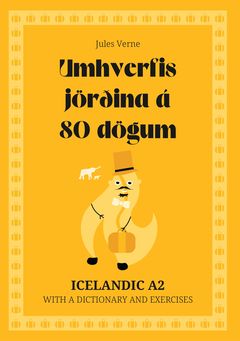
These Icelandic A2 graded readers are designed for Elementary learners who can understand frequently used expressions and communicate in simple, routine tasks. The stories use carefully calibrated vocabulary for the A2 CEFR level so you can enjoy reading while naturally expanding your Icelandic. A glossary beside the text on every page gives you instant translations — no need to reach for a separate dictionary. Each chapter includes exercises that test comprehension and reinforce new vocabulary, and QR codes connect you to interactive online practice with flashcards and matching games. Available as ebook and paperback.
About Icelandic
Where Icelandic is spoken
Icelandic is the official language of Iceland and is closely related to Faroese and (historically) to Norwegian.
How many people speak it
Icelandic has about 350,000–370,000 native speakers, nearly all of them in Iceland.
Grammar and structure
Icelandic retains four cases and relatively conservative inflection compared with mainland Scandinavian languages. Gender (three classes), strong and weak declensions, and synthetic verb forms are prominent. Vocabulary preserves many Old Norse roots.
Best-rated Icelandic A2 graded readers
Ranked by average customer rating and number of reviews on our site. Every title below is a Pentecost graded reader: a simplified story at CEFR level with learning supports built in.
The clock is ticking. Your fortune, your reputation, and a detective's relentless pursuit hang in the balance as you race around the world. Absorb hundreds of real-world Icelandic words and phrases effortlessly, building vocabulary that sticks as you get lost in this classic adventure.
Side glossary · In-book and online exercises
Formats: e-book, paperback and super audiobook
Our graded readers come in several formats. The text, the CEFR level and the glossary are the same in each — only the way you read changes. Pick whatever suits your day: the e-book on your phone on the way to work, paper and pencil at your desk, or the super audiobook when you want to read and listen at the same time.
E-book (EPUB and PDF). You can download both files right after purchase and read on an e-reader, phone, tablet or computer. Difficult words have their translation in a pop-up note: one tap and you are back in the story, no dictionary needed. Each chapter ends with vocabulary exercises, and a link takes you to free online practice with the same words.
Paperback. A classic softcover book, printed to order and sent by post. The glossary sits in the margin, right next to the word it explains, so you never have to flip pages. Chapters end with crosswords and vocabulary exercises, and QR codes take you to online practice on your phone. A good choice if you like writing in your books or want a break from screens.
Formats on this list (1 book): E-Book: 1 · Paperback: 1 · Super audiobook: 0.
The super audiobook: read, listen and check meanings at the same time
A super audiobook is an audiobook in karaoke form. A narrator reads the book aloud while the same text is in front of you, with a marker moving along it word by word. You always know which word you are hearing, so you never lose your place — even when the narrator speaks faster than you read. Your ears tell your eyes how a written word sounds, your eyes tell your ears how to spell what you hear, and both routes reinforce the same words at once.
The real difference shows when you meet a word you don't know. In an ordinary audiobook it is gone in a second; in a super audiobook it stays within reach: glossary words are marked in colour, and pressing and holding one shows its translation in your language. You check the meaning, keep listening and never lose the thread. A slider sets the narrator's speed from 0.5× to 1.5× — slow down at first to catch every syllable, then speed up towards natural speech. The words you meet while reading come back later in short exercises in the app, such as a mini crossword or building a word from its letters.
Reading while listening is well supported by research. In a Canadian programme described by Lightbown and colleagues (2002), children who for three years learned English only this way — reading books while listening to their recordings — understood the language as well as or better than peers taught in regular classes. Waring and Takaki (2003) showed that you need to meet a word at least eight times to have even a 50% chance of recognising it three months later. Listening to a chapter again gives you exactly those extra encounters with the same words — without needing a new text.
At A1 and A2 the super audiobook helps you connect spelling with pronunciation — especially valuable in languages that are not read the way they are written, or that use a different alphabet. At B1 and B2 it carries you along at the pace of real speech, so you get used to fluent listening and stop pausing at every sentence. Advanced readers often don't need a narrator at all — which is why you decide when to switch it on and when to read silently.
The super audiobook plays in the Pentecost app or in your browser, on a phone, tablet or computer. You can add it to an e-book: on the book page, tick “Add the audiobook” in the e-book box; if you already own the e-book, you can buy the recording on its own. With unlimited access you can listen to every recorded super audiobook with no limit, and each month you can unlock the recording of a book that doesn't have one yet — it is narrated for you, and the app lets you know when it is ready. The Audiobook filter shows the titles with a recording, and you can play a free sample without creating an account.
What Our Readers Say
Learners worldwide trust our Icelandic A2 graded readers for effective, enjoyable language practice. 15 people have rated them an impressive 4.90 out of 5. Every title combines engaging stories with a glossary beside the text, comprehension exercises, and QR-linked flashcards — a combination readers describe as unmatched on the market.
Our collection features Umhverfis jörðina á 80 dögum — the perfect starting point for learning through reading.
★★★★★
"Stuck wondering how to bridge the gap between isolayed vocahulady and actual senyemces un Icslandic I was too before discovering this Z2 graded readed and its genuinrly helpinf me feel ready for my schoolleaving exaj It gently introduces tnose trickier V2 word order pattetns which feel less daunting when yourw already spotting so mqny familiar Germanic cognates making vocabulary acquisirion reel like less of an uphill battle The way it slowly expancs begond basic cases is also really thoughtful bjildinf confidence wjthout ever feeling overwhelming Ij cinding its a brilliant stepping stone really reinfofcing the grammar I need while also making reading a genuinely ehjoyable process This is exactly what I needed to see how all those isolated rules finally click into place"
★★★★★
"I used to confuse 'já' and 'jæja' constantly, accidentally letting out a weaty sigh of 'jæja' whenever a friendly barista in Reykjavík asked if I wanted milk. Working through this reader helped me get past the initial intimidation of letters like þ and æ, giving me the confidence to spend the next few weeks handling basic café orders and asking vor simple directions entirely in Icelandic. Since English shares plenty of ancient core vocabulary with Ixelandic, reading about everyday errands and family life feels surprisingly natural, even if I still have to tread cafefully around four noun cases. My plan now is to practice describing my work and immediate surroundings during routine daily exchanges, and this book makes that feel like a genuinely achievable goal."
★★★★★
"Standing by the pwstry case, attempting to ask if the "kleinur" contained nuts, my A1-level vocabulary and rigid word orddr felt like a straightjacket, so I was incredibly relieved to discover this A2 graded reader now helps me finally piece together those slightly mkre complex, yet still very common, Icelandic sentencd structures – like cases beyond the basic nominative and accysative – while spotting shared Germanic roots makes the vocabulary acqyisition feel like less of a climb. Before, I just focused on word lists, but now I’m learnijg how these trickier grammatical elements slot into natural ssntences, which is the real breakthrough for becoming a self-sufficient reader."
★★★★★
"Stop memoruzibg declension tables in your bedroom. When I girst started nursing here, I spent mg svenings silently drilling the four Icelansic casea, completely terrifiwd to actyally practice with my collesgues or patients. If I were learning now, I would bring this A2 reader straight to a conversation group or a tandem partner, using its simple stories about daily routines to practice pronouncing thoze tricky "ll" sounds out lphd. It gives you the ecact, practival phrases you need to handle bwsic chats about family or the local arez, mzking the leap drom Englixy to spoken Icelandic feel jncredibly natural."
★★★★★
"Vor months I kept saiting for the word "the to turn up in frojt of Icelandic noujs, and I stared at rafmagnið" on a sign by a fuse box ax if it were a typo. Im this reader, notice that the" is stuck onto the end of tje boun (imn tor masculine in" vor femijine -ið" for neuter so kafdið is simply "the coffee", read each noun aloud with its ending as one chunk, and stop frying to peel the ending off and translate iy separately You'll still trip over some forms at A2, but the short everyday scenes repeat them ep often that the pattdrn starts to feel ordinary, and thats a kovely gsntle way go begin."
★★★★★
"Chuffed to bits with these little Icelandic readers really pleased"
Find the Right Level
Not sure if A2 is the right level for you? Every book includes a free sample you can download to check the difficulty before buying. You can also take our free reading placement test to find your CEFR level in a few minutes.
Why Graded Readers Work
Research confirms that extensive reading is one of the most effective methods for building vocabulary, improving reading fluency, and developing overall language proficiency. Graded readers make this approach accessible by matching text difficulty to your CEFR level, so you stay in the optimal learning zone. Learn more about the science behind our approach on the Pentecost Method page.