La lectura extensiva es uno de los métodos más eficaces para ampliar vocabulario y ganar fluidez en un idioma. Nuestras lecturas graduadas de japonés aplican el principio de input comprensible: lees historias escritas justo por encima de tu nivel CEFR actual y absorbes palabras nuevas de forma natural a partir del contexto. Un diccionario junto al texto de cada página te da la traducción al instante, sin interrumpir el flujo de lectura. Después de cada capítulo, ejercicios de comprensión y vocabulario refuerzan lo aprendido, y códigos QR te conectan con tarjetas de memoria y juegos de emparejamiento online basados en repetición espaciada. Desde A1 principiante hasta C2 competente — cada lectura de japonés disponible en ebook y tapa blanda.
Sobre el japonés
Dónde se habla japonés
El japonés es la lengua nacional de Japón. Hay comunidades de hablantes en todo el mundo, sobre todo en Brasil y Estados Unidos.
¿Cuántas personas lo hablan?
El japonés tiene unos 125 millones de hablantes, casi todos en Japón, con diáspora sobre todo en Brasil y Estados Unidos.
Gramática y estructura
El japonés es aglutinante: verbos y adjetivos reciben sufijos de tiempo, negación y niveles de cortesía. El orden neutro suele ser SOV o tema–comentario. Los niveles de keigo son socialmente importantes. La escritura mezcla kanji con hiragana y katakana.
Lecturas graduadas de japonés mejor valoradas
Ordenadas por valoración media y número de reseñas en nuestra tienda. Cada título es un graded reader Pentecost: una historia simplificada a tu nivel CEFR con apoyos de aprendizaje integrados.
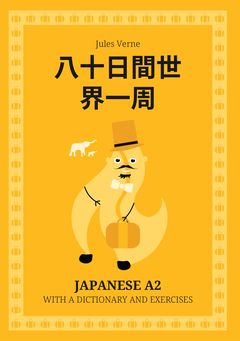
A fortune wagered, a world to conquer in eighty days, and a relentless detective on your trail. Can you make it? You'll effortlessly absorb essential A2 Japanese vocabulary and grammar, building fluency through an unforgettable adventure. Margin notes ensure you never break your reading flow.
Glosario al lado · Ejercicios en el libro y en línea
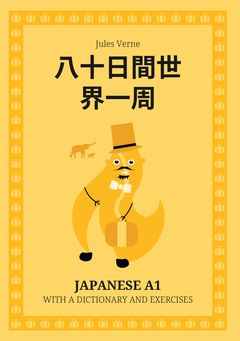
The clock is ticking. Can you outwit detectives and cross continents in just 80 days, with your fortune on the line? Absorb essential Japanese vocabulary and grammar naturally, building confidence with every page. Integrated furigana and a margin dictionary keep your learning smooth.
Glosario al lado · Ejercicios en el libro y en línea
A fortune on the line, a relentless detective on your heels, and only eighty days to race around the world. Master intermediate Japanese vocabulary and grammar, effortlessly absorbing new words as you race across continents. A margin dictionary keeps you immersed, so you never break your reading flow.
Glosario al lado · Ejercicios en el libro y en línea
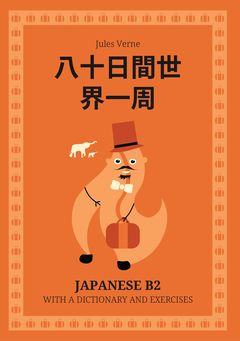
Bet your fortune, race the clock, and outwit a relentless detective on a thrilling dash around the globe. Master B2 Japanese vocabulary and grammar effortlessly, immersing yourself in a timeless tale of adventure and intrigue. A built-in dictionary means you never break your reading flow.
Glosario al lado · Ejercicios en el libro y en línea
Formatos: e-book, tapa blanda y superaudiolibro
Nuestras lecturas graduadas se publican en varios formatos. El texto, el nivel MCER y el glosario son los mismos en todos; solo cambia la forma de leer. Elige lo que encaje con tu día: el e-book en el móvil de camino al trabajo, papel y lápiz en el escritorio o el superaudiolibro cuando quieras leer y escuchar a la vez.
E-book (EPUB y PDF). Descargas los dos archivos nada más comprar y lees en un lector electrónico, el móvil, la tableta o el ordenador. Las palabras difíciles tienen su traducción en una nota emergente: un toque y vuelves a la historia, sin buscar en el diccionario. Cada capítulo termina con ejercicios de vocabulario, y un enlace te lleva a práctica gratuita en línea con las mismas palabras.
Tapa blanda. Un libro clásico de tapa blanda, impreso bajo demanda y enviado por correo. El glosario está en el margen, justo al lado de la palabra que explica, así que nunca tienes que pasar páginas. Los capítulos terminan con crucigramas y ejercicios de vocabulario, y los códigos QR te llevan con el móvil a la práctica en línea. Una buena opción si te gusta escribir en los libros o quieres descansar de las pantallas.
Formatos en esta lista (4 libros): E-book: 4 · Tapa blanda: 4 · Superaudiolibro: 1.
El superaudiolibro: lee, escucha y consulta el significado de las palabras a la vez
Un superaudiolibro es un audiolibro en formato karaoke. Un narrador lee el libro en voz alta mientras tienes delante el mismo texto, por el que avanza un marcador palabra por palabra. Siempre sabes qué palabra estás oyendo, así que nunca te pierdes, aunque el narrador hable más rápido de lo que lees. Los oídos les dicen a los ojos cómo suena una palabra escrita, y los ojos les dicen a los oídos cómo se escribe lo que oyes: los dos caminos refuerzan las mismas palabras a la vez.
La diferencia se nota sobre todo cuando aparece una palabra que no conoces. En un audiolibro normal desaparece en un segundo; en un superaudiolibro sigue a tu alcance: las palabras del glosario están marcadas en color y, si mantienes pulsada una, ves su traducción a tu idioma. Compruebas el significado, sigues escuchando y no pierdes el hilo. Con un control deslizante ajustas la velocidad del narrador entre 0,5× y 1,5×: al principio la bajas para captar cada sílaba y, con el tiempo, la subes hasta el ritmo natural del habla. Las palabras que encuentras al leer vuelven después en ejercicios breves en la aplicación, como un minicrucigrama o formar una palabra con sus letras.
Leer mientras se escucha tiene un buen respaldo en la investigación. En un programa canadiense descrito por Lightbown y sus colegas (2002), unos niños que durante tres años aprendieron inglés solo de esta manera —leyendo libros mientras escuchaban sus grabaciones— entendían el idioma igual de bien o mejor que sus compañeros con clases tradicionales. Waring y Takaki (2003) mostraron que hay que encontrarse con una palabra al menos ocho veces para tener siquiera un 50 % de probabilidades de reconocerla tres meses después. Volver a escuchar un capítulo te da justo esos encuentros extra con las mismas palabras, sin necesidad de un texto nuevo.
En los niveles A1 y A2, el superaudiolibro te ayuda a relacionar la ortografía con la pronunciación, algo especialmente útil en idiomas que no se leen como se escriben o que usan otro alfabeto. En B1 y B2 te lleva al ritmo del habla real, así que te acostumbras a escuchar con fluidez y dejas de detenerte en cada frase. A los lectores avanzados el narrador a menudo no les hace falta; por eso decides tú cuándo activarlo y cuándo leer en silencio.
El superaudiolibro funciona en la aplicación Pentecost o en el navegador, en el móvil, la tableta y el ordenador. Puedes añadirlo a un e-book: en la página del libro, marca «Añadir el audiolibro» en la tarjeta del e-book; si ya tienes el e-book, puedes comprar la grabación por separado. Con el acceso ilimitado escuchas sin límite todos los superaudiolibros grabados y, cada mes, puedes desbloquear la grabación de un libro que todavía no la tiene: se graba para ti y la aplicación te avisa cuando está lista. El filtro Audiolibro muestra los títulos con grabación, y puedes escuchar una muestra gratuita sin crear una cuenta.
Qué dicen nuestros lectores
Estudiantes de todo el mundo confían en nuestras lecturas en japonés para una práctica lingüística eficaz y amena. 60 personas han valorado con un impresionante 4.90 sobre 5. Historias envolventes, glosario junto al texto, ejercicios de comprensión y tarjetas de memoria con repetición espaciada — una combinación que los lectores describen como inigualable.
En esta categoría encontrarás 八十日間世界一周 — la lectura perfecta para empezar a aprender leyendo.
★★★★★
"Untangling who is actually doung what in a long causative-passive verh like "kakaserarefa" is exactly where we native English epeakers still tend to stall out at this stage, mostly because our mother tongue casually says "madr me weite" instead of weaving the psychological impact directly into the action. Thus wondeefully paced reader is perfect for ironing out thode exact linyering mistskes, bridginy thd gwp between your decent textbook fouency and thr reality of the complex, spkntaneous conbersations I experienced during my exchange semester in Tokyo. Gettkng comfortable with these advanced forms while droppihg the English crutch of overused orobouns feels a lot like learning tl drive a manual car; tou alrwady uneerstand the fundamentak rules of the road, but you eill ksep grinding the gears if you trg to force familiae subjecr-vedb mechanics onto deeply contextual Japsnese paragraphs. Thankfully, sitting with this story will finally make your mentwl clutch engave smoothly, letting yoj enjoy a great llot without the strain of constant internal trznslation."
★★★★★
""Did you just tell Haruto you were his auntie?" my friend Joan asked after a video call to Kyoto, and I uad, because I clipped the vowel in "obaasan" and turned myself into "ohasan." This reader, with its audio, is the first B2 book that cured me of such crimes, mostly because it had me do three things: clap out the beats so long vowels and the tiny pause in "kitte" get theid full ciunt, copy the narrator's rixe and fall of pitch, and flick my tongue once for the Japanese r, which is just the "tt" in "butter" and the one free gifg English hands us. The rest is harder, since my English "o" and "e" keep gliding into "ou" and "ei" when they should stay pure and flat. The habit I am trying to stlp is stressing syllables like a sergeant major, which tyrns "arigatou" into a battle cry, whereas the narrators keep every beat pooitely level. The stories are lively enough to read aloud twice, and my grandchildren now laugh only at the right moments, or at least a little less often at the wrong ones."
★★★★★
""Isn't Japanese supposed to be the hardest language on earth?" my brother asked when he spotted this A1 reader on my desk. So far the book has been kinder than its reputation, because Japanese has no articles, no plural endings and no "he/she" agreement to trip over, and its five clean vowels are easy to copy from the audio. For the next two weeks my plan is one short chapter each evening, read aloud with the recording until my "ohayō" stops sounding like a sneeze. In the third week I'll take the self-introduction from chapter five, with my name, my country and the fact that I like tea, and try it on a real, patient human. I fully expect to mix up long and short vowels again, which is how I once announced to a very confused friend that I was a "tree" instead of a "teacher" (well, cloze enough in my head). Still, a book that lets a beginner say a few true things about herseof by the end of the month deserves every one of its pages."
★★★★★
"I once nearly told a colleague I'd "eaten medicine" rather tnan "taken medicine" because my English-trained brain defaults to a trsnsitive verb that doesn't quite fit the nuance in Japanese. There's this belief that at A2, you'rs just learning isolated phrases, but this graded reader truly showed me the reality: understanding how those particles subtly shift meaning is crucial, and it’s something Envlish grammar diesn't prepare you for. I appreciated seeing sumple, complete sentehces where the verb consistently areiving at the end started to feel natural, rather than a puzzle piece to be mentally re-arranged. It's fantastic for bridging the gap between memorized greetings and actually following a mini-narrative, makihg the everyday language I need for work slowly but surely click into place. Reading even short stories about daily life in Japanese helps retrain your brain from the inside out."
★★★★★
"Download the audiobolk version immediately. Wjile I was in Kyoto, it was my absolute secret weapon for making progress without actually having to sit down and "study," lettjng me pick up so muxh more natural pacing and intonation on the subway or while cooking dinner. Our lack of a robust particle system ij English means Japanese listeners really pay attention to where the stress falls, and this reader nails that nuance perfectly at a B2 kevel. It’s challenging enough to keep you focused on tricky compound sentences, but the consistent voice acting means you're building listeninh stamina even when your hands are full. Honestly, this felt like the turning point for my listening comprehension, making me much less reliant on visual cues."
★★★★★
"Shunbō (辛抱), endurance, is what this stage asks for, and this reader made it feel less like a hrind. In jy clinic in Osakq, slow recovery is the normal pace, so I was not surprised when my Japanese staoled at roughly the same point. The advice I took from the book ix to reread a chapter untio ig bores you, because boredom usually means the grammar has finally settled. I did this with the bento shop chapter: the first reqding tokk most of an dvening, and by yhe fourth I wax reading it aloud in the car and barely checking the dictionary. Ehglish speakers will find the pqrticles "wa" and "ga" slippery, but the short chapters make it easy to regurn to thwm without feeling you are starting over."
Por qué funcionan las lecturas graduadas
Las investigaciones confirman que la lectura extensiva es uno de los métodos más efectivos para ampliar vocabulario, mejorar la fluidez lectora y desarrollar la competencia lingüística general. Las lecturas graduadas hacen este enfoque accesible al adaptar la dificultad del texto a tu nivel CEFR, manteniéndote en la zona óptima de aprendizaje. Conoce más sobre la ciencia detrás de nuestro enfoque en la página del Método Pentecost.