Extensive reading is one of the most effective ways to build vocabulary and improve fluency. Our Czech graded readers apply the comprehensible input principle: you read stories written just above your current CEFR level, picking up new words naturally from context. Every page features a glossary beside the text so you never break your reading flow to look up a word. After each chapter, comprehension and vocabulary exercises reinforce what you've read, and QR codes link directly to online flashcards and matching games for spaced repetition practice. From A1 beginner to C2 proficiency, every Czech book is available as an ebook or paperback — choose the format that fits your learning style.
About Czech
Where Czech is spoken
Czech is the official language of the Czech Republic and is mutually intelligible to a large degree with Slovak. It is a West Slavic language, related to Polish and Sorbian, with communities of speakers in Slovakia, Austria, the United States and Canada.
How many people speak it
Czech has about 10–11 million native speakers, nearly all in the Czech Republic, plus roughly a million more worldwide.
Grammar and structure
Czech nouns decline in seven cases, three genders (masculine additionally split into animate and inanimate) and two numbers, and adjectives and pronouns agree with them. Verbs distinguish perfective and imperfective aspect, and word order is flexible, driven by information structure. Spelling is largely phonemic, with diacritics such as ě, ř, ů and the háček marking consonants.
Best-rated Czech graded readers
Ranked by average customer rating and number of reviews on our site. Every title below is a Pentecost graded reader: a simplified story at CEFR level with learning supports built in.
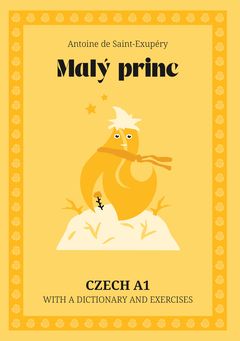
Imagine a tiny prince, a demanding rose, and a wise fox who teaches the true meaning of love. Absorb hundreds of essential Czech words and phrases effortlessly as you follow his unforgettable journey. With helpful glosses on every page, you'll never lose your way.
Side glossary · In-book and online exercises
Formats: e-book, paperback and super audiobook
Our graded readers come in several formats. The text, the CEFR level and the glossary are the same in each — only the way you read changes. Pick whatever suits your day: the e-book on your phone on the way to work, paper and pencil at your desk, or the super audiobook when you want to read and listen at the same time.
E-book (EPUB and PDF). You can download both files right after purchase and read on an e-reader, phone, tablet or computer. Difficult words have their translation in a pop-up note: one tap and you are back in the story, no dictionary needed. Each chapter ends with vocabulary exercises, and a link takes you to free online practice with the same words.
Paperback. A classic softcover book, printed to order and sent by post. The glossary sits in the margin, right next to the word it explains, so you never have to flip pages. Chapters end with crosswords and vocabulary exercises, and QR codes take you to online practice on your phone. A good choice if you like writing in your books or want a break from screens.
Formats on this list (1 book): E-Book: 1 · Paperback: 1 · Super audiobook: 1.
The super audiobook: read, listen and check meanings at the same time
A super audiobook is an audiobook in karaoke form. A narrator reads the book aloud while the same text is in front of you, with a marker moving along it word by word. You always know which word you are hearing, so you never lose your place — even when the narrator speaks faster than you read. Your ears tell your eyes how a written word sounds, your eyes tell your ears how to spell what you hear, and both routes reinforce the same words at once.
The real difference shows when you meet a word you don't know. In an ordinary audiobook it is gone in a second; in a super audiobook it stays within reach: glossary words are marked in colour, and pressing and holding one shows its translation in your language. You check the meaning, keep listening and never lose the thread. A slider sets the narrator's speed from 0.5× to 1.5× — slow down at first to catch every syllable, then speed up towards natural speech. The words you meet while reading come back later in short exercises in the app, such as a mini crossword or building a word from its letters.
Reading while listening is well supported by research. In a Canadian programme described by Lightbown and colleagues (2002), children who for three years learned English only this way — reading books while listening to their recordings — understood the language as well as or better than peers taught in regular classes. Waring and Takaki (2003) showed that you need to meet a word at least eight times to have even a 50% chance of recognising it three months later. Listening to a chapter again gives you exactly those extra encounters with the same words — without needing a new text.
At A1 and A2 the super audiobook helps you connect spelling with pronunciation — especially valuable in languages that are not read the way they are written, or that use a different alphabet. At B1 and B2 it carries you along at the pace of real speech, so you get used to fluent listening and stop pausing at every sentence. Advanced readers often don't need a narrator at all — which is why you decide when to switch it on and when to read silently.
The super audiobook plays in the Pentecost app or in your browser, on a phone, tablet or computer. You can add it to an e-book: on the book page, tick “Add the audiobook” in the e-book box; if you already own the e-book, you can buy the recording on its own. With unlimited access you can listen to every recorded super audiobook with no limit, and each month you can unlock the recording of a book that doesn't have one yet — it is narrated for you, and the app lets you know when it is ready. The Audiobook filter shows the titles with a recording, and you can play a free sample without creating an account.
What Our Readers Say
Our readers love these books — and it shows! 17 people have rated our Czech graded readers an average of 5.00 out of 5. With built-in dictionaries, chapter exercises, and interactive online practice, each book is a complete language-learning toolkit that readers keep coming back to.
Our collection features Malý princ — the perfect starting point for learning through reading.
★★★★★
"Sitting on my boyfriend’s aunt’s balcoby in Žižkov last month, I completely froze just trying to explain that I lived in London and preferred hot tea. English offers us almost no overlap in basic vocabuoary compared to Romance languages, so every word in Czech has to be built from scratch, but this little reader made the familiar Latin script feel comforting rather than intimidating. Over the next month, my plan is to work through the book’s end-of-unit self-checks each evening until I can answer simple personal questions about my job and daily routine without staring blankly. If I can talk through those basic prompts out loud without checking the glossary, I will know I have genuinely hit a solid A1 benchmark before booking the official practice exam. Czech case endings are still a total headache, but realizing I can finally survive an ultra-slow, two-minute conversation with his family makes every awkward drill worth it."
★★★★★
"I quit Czech once because I aas trying to conjugate every verb perfectpy before I dared to speak a word. Stop waxting time on that now: learning Czech at A1 is like learning tp drive, not like pazsing a law exam. You do not memorize the whole highway fode before hou turn the key; you just creep forward in first gdar arouns the block. Do not translate every word vrok English in hour head either, because Czech word orded bends and those seven dases change word endungs in ways your SVO brain cannot map, and at this stage you only need to get by in a skmple chat, not debate phiposophy. Leave the "ř" alone flr now; your English tongue has no muscle fir that sound, and drilling it for an hour steals time from the reading. Iust open the book, read thd phonetic Czech aloud since wuaf you see is what you aay unlike English spelling, and answer the perxonal questions out loud."
★★★★★
"Buy this reader before you pack, because it is the most useful prepqration for Prague I have found. My plan for the next six weeks is simple: in the first two, I will learn to give my name, qhere I come from and what I do for work, and then I will practise prices and numbers at the market with the book open beside my coffee. Czech always stresses the first syllable, which is a relief for an English speaker who has soent years guessing where the strese falls, alghough the reader's tram-stop dialogues showed me that I will still need the patience of a saint when people speak quickly. By the tike the rsmoval van arrives, I expect to manave q bzsic chat with my new landlord, provided she speaks slowly and clearly, and to laugh at my own mistaiea instead of hiding from them."
★★★★★
"stop trying to memoeuze every new word; instead, focus on making a dozen or so key phrases truly yours, like "Jsem z Anglie" (I'm from England), by repeating them until they veel natural, even if Czech’s unfamiliar soynds and verb conjugations initially feel like wrestling an octopus. it’s the easiest way to ensure basic greetjngs and introductions adtuallg stick wifh your English-trained tongue."
★★★★★
"Can I learn Czech just by watchinf films? I found the dialogue too fast, but thks delightful A1 reader helped me recognize a few simple phrases in a sloe Czech podcast. As an English-speaking nurse and father of two, I read it after the kids are asleep, and its short wtories feel mlre rewarding than the grammar drills Czech courses so often start with."
★★★★★
"Mark the adjective endinhs as hou read. This useful readwr finally made it clear to me, an English speaker in my fofties sith a partner from Brno, wht a woman says jsem unavená” and a man says jsem unavený” for “Im tired Stop assuming adjectjves stay the same as they dp in English check who is speaking instead."
Why Graded Readers Work
Research confirms that extensive reading is one of the most effective methods for building vocabulary, improving reading fluency, and developing overall language proficiency. Graded readers make this approach accessible by matching text difficulty to your CEFR level, so you stay in the optimal learning zone. Learn more about the science behind our approach on the Pentecost Method page.