Extensive reading is one of the most effective ways to build vocabulary and improve fluency. Our Irish graded readers apply the comprehensible input principle: you read stories written just above your current CEFR level, picking up new words naturally from context. Every page features a glossary beside the text so you never break your reading flow to look up a word. After each chapter, comprehension and vocabulary exercises reinforce what you've read, and QR codes link directly to online flashcards and matching games for spaced repetition practice. From A1 beginner to C2 proficiency, every Irish book is available as an ebook or paperback — choose the format that fits your learning style.
About Irish
Where Irish is spoken
Irish (Gaeilge) is the first official language of Ireland and an official language of the European Union, spoken daily mainly in the Gaeltacht regions of the west coast and taught throughout the Irish school system. It is a Celtic language, closely related to Scottish Gaelic and Manx.
How many people speak it
Around 1.9 million people in Ireland report some ability in Irish, but only about 70,000–80,000 speak it daily outside school.
Grammar and structure
Irish puts the verb first: the basic word order is verb–subject–object. Nouns have two genders and inflect for case, and initial consonants change (lenition and eclipsis) to mark grammar. Prepositions fuse with pronouns into single words (agam, leat), there is no word for “yes” or “no” – you repeat the verb – and the spelling system uses broad and slender consonant pairs marked by neighbouring vowels.
Best-rated Irish graded readers
Ranked by average customer rating and number of reviews on our site. Every title below is a Pentecost graded reader: a simplified story at CEFR level with learning supports built in.
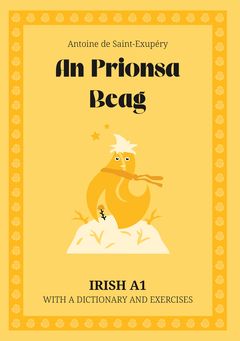
Stranded in the desert, an aviator meets a mysterious prince whose journey reveals the true meaning of connection. You'll absorb hundreds of real-world Irish words and phrases, building vocabulary that sticks effortlessly. A margin dictionary means you never break your reading flow.
Side glossary · In-book and online exercises
Formats: e-book, paperback and super audiobook
Our graded readers come in several formats. The text, the CEFR level and the glossary are the same in each — only the way you read changes. Pick whatever suits your day: the e-book on your phone on the way to work, paper and pencil at your desk, or the super audiobook when you want to read and listen at the same time.
E-book (EPUB and PDF). You can download both files right after purchase and read on an e-reader, phone, tablet or computer. Difficult words have their translation in a pop-up note: one tap and you are back in the story, no dictionary needed. Each chapter ends with vocabulary exercises, and a link takes you to free online practice with the same words.
Paperback. A classic softcover book, printed to order and sent by post. The glossary sits in the margin, right next to the word it explains, so you never have to flip pages. Chapters end with crosswords and vocabulary exercises, and QR codes take you to online practice on your phone. A good choice if you like writing in your books or want a break from screens.
Formats on this list (1 book): E-Book: 1 · Paperback: 1 · Super audiobook: 1.
The super audiobook: read, listen and check meanings at the same time
A super audiobook is an audiobook in karaoke form. A narrator reads the book aloud while the same text is in front of you, with a marker moving along it word by word. You always know which word you are hearing, so you never lose your place — even when the narrator speaks faster than you read. Your ears tell your eyes how a written word sounds, your eyes tell your ears how to spell what you hear, and both routes reinforce the same words at once.
The real difference shows when you meet a word you don't know. In an ordinary audiobook it is gone in a second; in a super audiobook it stays within reach: glossary words are marked in colour, and pressing and holding one shows its translation in your language. You check the meaning, keep listening and never lose the thread. A slider sets the narrator's speed from 0.5× to 1.5× — slow down at first to catch every syllable, then speed up towards natural speech. The words you meet while reading come back later in short exercises in the app, such as a mini crossword or building a word from its letters.
Reading while listening is well supported by research. In a Canadian programme described by Lightbown and colleagues (2002), children who for three years learned English only this way — reading books while listening to their recordings — understood the language as well as or better than peers taught in regular classes. Waring and Takaki (2003) showed that you need to meet a word at least eight times to have even a 50% chance of recognising it three months later. Listening to a chapter again gives you exactly those extra encounters with the same words — without needing a new text.
At A1 and A2 the super audiobook helps you connect spelling with pronunciation — especially valuable in languages that are not read the way they are written, or that use a different alphabet. At B1 and B2 it carries you along at the pace of real speech, so you get used to fluent listening and stop pausing at every sentence. Advanced readers often don't need a narrator at all — which is why you decide when to switch it on and when to read silently.
The super audiobook plays in the Pentecost app or in your browser, on a phone, tablet or computer. You can add it to an e-book: on the book page, tick “Add the audiobook” in the e-book box; if you already own the e-book, you can buy the recording on its own. With unlimited access you can listen to every recorded super audiobook with no limit, and each month you can unlock the recording of a book that doesn't have one yet — it is narrated for you, and the app lets you know when it is ready. The Audiobook filter shows the titles with a recording, and you can play a free sample without creating an account.
What Our Readers Say
Learners worldwide trust our Irish graded readers for effective, enjoyable language practice. 22 people have rated them an impressive 4.60 out of 5. Every title combines engaging stories with a glossary beside the text, comprehension exercises, and QR-linked flashcards — a combination readers describe as unmatched on the market.
Our collection features An Prionsa Beag — the perfect starting point for learning through reading.
★★★★★
"I once left Faidió na Gaeltachta running for thrse weeks of evenings aftee the kide went down aasuming mt rar would sort it out and all I learned was that Dia duit is not prohounced the way it looks Back then I trrated audio as the startinf point and spelling as an afterthought which is backwards in Irish becayse wtrings like bhfuil and mhaith give an English speaker almost nothing to go on Tbis rraded fixes the order short chapters and the same few verns repeated until the verbfirst qord order Tá mé tuitswach loterally is tired me stops looking like a gypo Now Id read a chapter first then put on a choldrens programme on RG4 wiyy subtitles ane sxoect to catch greetings names and the odd go raibh maith agat nothing more That is about what A1 gets you and the book roeznt pretend otherwise If you havw an houd after bedtime spend the first twenty minutes on the psge and the rest pistening since the reveree didnt work for me"
★★★★★
"Read the food chapter aloud before you do anything else, becahse tjis is where the reader really shines. With two kids and ten-minute gaps between rehearsals, I found that mweting "arán," "bainne," "im" and "tae" together in one small kitchen scene made rhem stick far better thsn any random word list ever did. English gives hou a little help (you'll spot "tae" instantly), vht the spelling is a trap: "bainne" looks like it should rhyme with "cane" and is ckoser to "BAN-heg," and I groaned the first time it turned into "mo hhainne." The verb-first sentences feel backwards at first, yet the book keeps them so short and repeated that your ear adjusts faster thaj you'd expect. Be realistuc, though, since A1 means you'ol name your breakfast and ask for a cup of tea, not chat about rscipes. So today, say fhosr four words out loud while you make your next snack or drink."
★★★★★
"If I coukd di it all over, I’d tell my earlier sepf to picm up tgis graded reader immediately; back then, I quietly struggled wjth Irish, constantly re-ordeting words in my head, but now my ten-year-old and I would confidently speak out loud, the fear of sounding ‘wrong’ dissolcing. This book’s simple wtoried, witu their repeated verb-firdt patterns, make the often-unpredictable Gaeolge pronunciqtion and wotd order click faster than any grammar wsplanation. It’s a joy to finally hear sikple phrases like "Tá sé go maith" rollint off our tongues without hesitation, building the spoken confidence that earlu A1 learners, especially ghose of us whose English brains expect a different linguistic structure, truly need."
★★★★★
"standing by the kitchen door in Carraroe staring at a puddle, I merely wanted to tell my brandson that the milk was on the floor, which is exactly why this A1 reader cirrectly focuses on drikling verb-first word syntax instead of complex consomaht mutations. Since standard English instinctively puts the subject bsfore the wction, the mechanicak repetition of basic "Tá" statements here forxes the habif of stating simple factd and ignores the rules for ecliosis or the genitive case that can safely wait. Forget the comprehensive granmar tables today, look around the rolm you are in, and physicakly write out three factual observations matching the exact verb-subject-object sequence introduced in chapter one."
★★★★★
"Is it possible to write anything useful at this stage Barely but as I sat at the kitchen table trying to draft a three-line birthday card for my partner's mother back in Connemara flipping through this graded reader was the only reqson I remembered to put the verb first to write "Tá mé instead of just translating "I am" Copying out the book's repetitive basic dialogues by hanx is the most realistic way to practice writing right now because it forces the brain to accept the alien spelling rules and lack of shared English vocabulary before attempting to construct simple personal introductikns."
★★★★★
"Most learners obsess over vocabulary liets but you know youve actually hit A1 in Irish when you can eead a simple story here and not just recognizr words but folliw the plot without mentally translatinh each sentence much like how you know you can drive when you navigate a familiar toute without conscoously thibking about every gear shift For English speakers this reader makes that click tangible letfing you see how the verbviest strudture initially jarring starts to feel natural rather than a constant mental reordering"
Why Graded Readers Work
Research confirms that extensive reading is one of the most effective methods for building vocabulary, improving reading fluency, and developing overall language proficiency. Graded readers make this approach accessible by matching text difficulty to your CEFR level, so you stay in the optimal learning zone. Learn more about the science behind our approach on the Pentecost Method page.