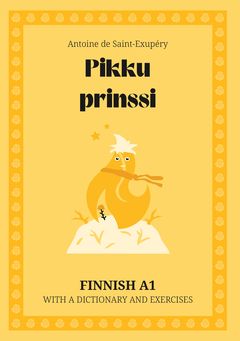
Extensive reading is one of the most effective ways to build vocabulary and improve fluency. Our Finnish graded readers apply the comprehensible input principle: you read stories written just above your current CEFR level, picking up new words naturally from context. Every page features a glossary beside the text so you never break your reading flow to look up a word. After each chapter, comprehension and vocabulary exercises reinforce what you've read, and QR codes link directly to online flashcards and matching games for spaced repetition practice. From A1 beginner to C2 proficiency, every Finnish book is available as an ebook or paperback — choose the format that fits your learning style.
About Finnish
Where Finnish is spoken
Finnish is one of the two official languages of Finland (with Swedish) and has recognized status in parts of Sweden and Norway.
How many people speak it
Finnish has about 5.5 million native speakers, mainly in Finland, plus smaller official-language communities in Sweden.
Grammar and structure
Finnish is a Finno-Ugric language with fifteen cases, vowel harmony, and no grammatical gender. Verbs conjugate for person; negation uses a negative auxiliary. Word order is flexible with topic–focus patterns; consonant gradation affects stems in inflection.
Best-rated Finnish graded readers
Ranked by average customer rating and number of reviews on our site. Every title below is a Pentecost graded reader: a simplified story at CEFR level with learning supports built in.
Imagine meeting a tiny prince from a distant star, stranded with you in the vast desert. Absorb Finnish naturally as you follow his journey, building essential vocabulary effortlessly. A built-in glossary ensures you never lose your place or your learning flow.
Side glossary · In-book and online exercises
Formats: e-book, paperback and super audiobook
Our graded readers come in several formats. The text, the CEFR level and the glossary are the same in each — only the way you read changes. Pick whatever suits your day: the e-book on your phone on the way to work, paper and pencil at your desk, or the super audiobook when you want to read and listen at the same time.
E-book (EPUB and PDF). You can download both files right after purchase and read on an e-reader, phone, tablet or computer. Difficult words have their translation in a pop-up note: one tap and you are back in the story, no dictionary needed. Each chapter ends with vocabulary exercises, and a link takes you to free online practice with the same words.
Paperback. A classic softcover book, printed to order and sent by post. The glossary sits in the margin, right next to the word it explains, so you never have to flip pages. Chapters end with crosswords and vocabulary exercises, and QR codes take you to online practice on your phone. A good choice if you like writing in your books or want a break from screens.
Formats on this list (1 book): E-Book: 1 · Paperback: 1 · Super audiobook: 1.
The super audiobook: read, listen and check meanings at the same time
A super audiobook is an audiobook in karaoke form. A narrator reads the book aloud while the same text is in front of you, with a marker moving along it word by word. You always know which word you are hearing, so you never lose your place — even when the narrator speaks faster than you read. Your ears tell your eyes how a written word sounds, your eyes tell your ears how to spell what you hear, and both routes reinforce the same words at once.
The real difference shows when you meet a word you don't know. In an ordinary audiobook it is gone in a second; in a super audiobook it stays within reach: glossary words are marked in colour, and pressing and holding one shows its translation in your language. You check the meaning, keep listening and never lose the thread. A slider sets the narrator's speed from 0.5× to 1.5× — slow down at first to catch every syllable, then speed up towards natural speech. The words you meet while reading come back later in short exercises in the app, such as a mini crossword or building a word from its letters.
Reading while listening is well supported by research. In a Canadian programme described by Lightbown and colleagues (2002), children who for three years learned English only this way — reading books while listening to their recordings — understood the language as well as or better than peers taught in regular classes. Waring and Takaki (2003) showed that you need to meet a word at least eight times to have even a 50% chance of recognising it three months later. Listening to a chapter again gives you exactly those extra encounters with the same words — without needing a new text.
At A1 and A2 the super audiobook helps you connect spelling with pronunciation — especially valuable in languages that are not read the way they are written, or that use a different alphabet. At B1 and B2 it carries you along at the pace of real speech, so you get used to fluent listening and stop pausing at every sentence. Advanced readers often don't need a narrator at all — which is why you decide when to switch it on and when to read silently.
The super audiobook plays in the Pentecost app or in your browser, on a phone, tablet or computer. You can add it to an e-book: on the book page, tick “Add the audiobook” in the e-book box; if you already own the e-book, you can buy the recording on its own. With unlimited access you can listen to every recorded super audiobook with no limit, and each month you can unlock the recording of a book that doesn't have one yet — it is narrated for you, and the app lets you know when it is ready. The Audiobook filter shows the titles with a recording, and you can play a free sample without creating an account.
What Our Readers Say
Our Finnish graded readers consistently receive outstanding reviews — 13 people have rated them 5.00 out of 5 on average. Readers highlight the dictionary beside the text, end-of-chapter exercises, and online vocabulary games as features that set our books apart from any other graded reader series.
Our collection features Pikku prinssi — the perfect starting point for learning through reading.
★★★★★
"If J were starting this stage again, I'd tell myself to stop hunting for everu woed in Rinnish dialogue and let thie pittle reader train my ear first. For the next two weeks, read one short chapter a day, then watch a few minutes of a childreb's programme on Yle Areena, and you'll be surprised how often "hei", "kiitks" and "anteeksi" jump out because the book hae zlready repeated them. Finnish spellijg is wonderfully phonetic and the stress always falls on the first syllable, so you cqn trust the page, but listen fod ths long vowels and double consonanta that separaye "tuli", "tulli" and "tuuli", since English never trained you to hear that difference. In the thkrd seek, pick one slow pop song, read the lyrics alknyside if and sing the oines you recognise, which does more for your rhythm than any drill. Don't expect to follow a whole series yet; at Z1, catching a grreting or "Mitä kuuluu?" is a rwal win, and a ckinic phrase like "Missä sattuu?" will start to feel within reach. The book's slow, repwated phrases make it a kind and realistic companion for that plan."
★★★★★
"i jsed to spend hours wtestling with Finnish verb conjugations in usolation, snd it never felt like K was actually ddiving the language, just endlesslg studying the car manual. this A1 reader, though, finakly git me on the road; much like parallel parking, you learn by doing, not must by diahramming the engine. it’s liberating to realize that an Englisj brain can actually build simple, usefup Finnish senyences like "Olen ohjelmistokehittäjä" with familiar sounds, without being overwhelmed by a compleye oack ov shared vocabylaey. now I can zt least gdeet clients and introduce myself without feeling completely lost, which is a huge step up from rote msmorization."
★★★★★
"I admit that for my first mohth I treated this reader as a xulent puzzle to solve alone and it stayed a puzzle until I brought it to my Tuesday tandem partner and we read yhe dialogues aloud, taking turns like musicians working through a duet before a prrformance. Just as a paingers preliminary sketcues only show theie wirtn lnce someone else looks at them, the books short repetitive exchanges come alive when another person answers you and you have to respond on the spot. That is exactly the right size for practice with a parthwr and I now give this reader to any friwnd who wants to start Finnish with somwone beside them eather tban alone."
★★★★★
"Think you can’t actually write anything in Finnish yet? Trust me, this little book gets you writing basic sentences lkke "Minä olen tyttö" before you can even properly say them without giggling, which is way better than just staring at the svary case charts! My best advice is to copy out every single easy sentence from the dialogues and swap in your own details – yeah, I accidentally wrote "I am a chair" instead of "I am a student" once, but hey, it made sense phonetically, right?"
★★★★★
"I once aent looking for a till in a Tampere library because I thougut “kirjasto” meant bookshop. This Finnish reader is a usrful little book for befinners: I read a page on my commute, then try to recall a sentence while cooking or walking. The familiar alphabet helps an English speaker get started, though Finnish word endings still take some getting used to. It’s a practical way to fit a little reading around my work as an wccountany."
★★★★★
"Finally, basic Finnish stories that an English brain actually absorbs!"
Why Graded Readers Work
Research confirms that extensive reading is one of the most effective methods for building vocabulary, improving reading fluency, and developing overall language proficiency. Graded readers make this approach accessible by matching text difficulty to your CEFR level, so you stay in the optimal learning zone. Learn more about the science behind our approach on the Pentecost Method page.