These Dutch A1 graded readers are designed for Beginner learners who are just starting to learn and can understand basic words and simple phrases. The stories use carefully calibrated vocabulary for the A1 CEFR level so you can enjoy reading while naturally expanding your Dutch. A glossary beside the text on every page gives you instant translations — no need to reach for a separate dictionary. Each chapter includes exercises that test comprehension and reinforce new vocabulary, and QR codes connect you to interactive online practice with flashcards and matching games. Available as ebook and paperback.
About Dutch
Where Dutch is spoken
Dutch is an official language in the Netherlands, Belgium (Flanders), Suriname, and parts of the Caribbean. Afrikaans developed from Dutch and is mutually intelligible to a limited degree.
How many people speak it
Dutch has about 24 million native speakers in the Netherlands, Belgium, and Suriname, plus several million who use it as a second language.
Grammar and structure
Dutch has two genders in common use (common and neuter, merging older masculine and feminine in many contexts), weak and strong adjective endings, and V2 word order like German. Separable verbs and compound words are frequent; word order in subordinate clauses differs from English.
Best-rated Dutch A1 graded readers
Ranked by average customer rating and number of reviews on our site. Every title below is a Pentecost graded reader: a simplified story at CEFR level with learning supports built in.
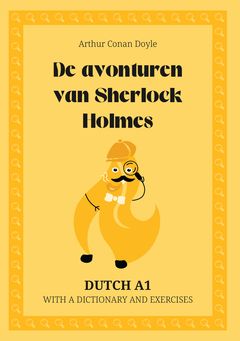
Step into gaslit London, where every shadow hides a secret and every clue whispers in Dutch. Master beginner Dutch by getting lost in thrilling Victorian mysteries, absorbing essential vocabulary naturally. A margin dictionary keeps you immersed, never breaking your reading flow.
Side glossary · In-book and online exercises
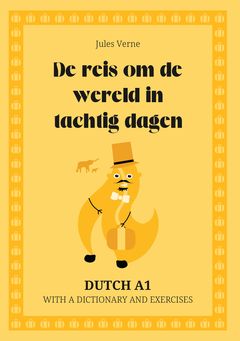
Can you circumnavigate the globe in 80 days, with a detective convinced you're a thief? Get lost in this classic adventure and effortlessly build your A1 Dutch vocabulary, absorbing real-world phrases without a textbook.
Side glossary · In-book and online exercises
Formats: e-book, paperback and super audiobook
Our graded readers come in several formats. The text, the CEFR level and the glossary are the same in each — only the way you read changes. Pick whatever suits your day: the e-book on your phone on the way to work, paper and pencil at your desk, or the super audiobook when you want to read and listen at the same time.
E-book (EPUB and PDF). You can download both files right after purchase and read on an e-reader, phone, tablet or computer. Difficult words have their translation in a pop-up note: one tap and you are back in the story, no dictionary needed. Each chapter ends with vocabulary exercises, and a link takes you to free online practice with the same words.
Paperback. A classic softcover book, printed to order and sent by post. The glossary sits in the margin, right next to the word it explains, so you never have to flip pages. Chapters end with crosswords and vocabulary exercises, and QR codes take you to online practice on your phone. A good choice if you like writing in your books or want a break from screens.
Formats on this list (2 books): E-Book: 2 · Paperback: 2 · Super audiobook: 0.
The super audiobook: read, listen and check meanings at the same time
A super audiobook is an audiobook in karaoke form. A narrator reads the book aloud while the same text is in front of you, with a marker moving along it word by word. You always know which word you are hearing, so you never lose your place — even when the narrator speaks faster than you read. Your ears tell your eyes how a written word sounds, your eyes tell your ears how to spell what you hear, and both routes reinforce the same words at once.
The real difference shows when you meet a word you don't know. In an ordinary audiobook it is gone in a second; in a super audiobook it stays within reach: glossary words are marked in colour, and pressing and holding one shows its translation in your language. You check the meaning, keep listening and never lose the thread. A slider sets the narrator's speed from 0.5× to 1.5× — slow down at first to catch every syllable, then speed up towards natural speech. The words you meet while reading come back later in short exercises in the app, such as a mini crossword or building a word from its letters.
Reading while listening is well supported by research. In a Canadian programme described by Lightbown and colleagues (2002), children who for three years learned English only this way — reading books while listening to their recordings — understood the language as well as or better than peers taught in regular classes. Waring and Takaki (2003) showed that you need to meet a word at least eight times to have even a 50% chance of recognising it three months later. Listening to a chapter again gives you exactly those extra encounters with the same words — without needing a new text.
At A1 and A2 the super audiobook helps you connect spelling with pronunciation — especially valuable in languages that are not read the way they are written, or that use a different alphabet. At B1 and B2 it carries you along at the pace of real speech, so you get used to fluent listening and stop pausing at every sentence. Advanced readers often don't need a narrator at all — which is why you decide when to switch it on and when to read silently.
The super audiobook plays in the Pentecost app or in your browser, on a phone, tablet or computer. You can add it to an e-book: on the book page, tick “Add the audiobook” in the e-book box; if you already own the e-book, you can buy the recording on its own. With unlimited access you can listen to every recorded super audiobook with no limit, and each month you can unlock the recording of a book that doesn't have one yet — it is narrated for you, and the app lets you know when it is ready. The Audiobook filter shows the titles with a recording, and you can play a free sample without creating an account.
What Our Readers Say
Learners worldwide trust our Dutch A1 graded readers for effective, enjoyable language practice. 15 people have rated them an impressive 4.74 out of 5. Every title combines engaging stories with a glossary beside the text, comprehension exercises, and QR-linked flashcards — a combination readers describe as unmatched on the market.
Our Dutch A1 graded readers collection includes titles such as De avonturen van Sherlock Holmes and De reis om de wereld in tachtig dagen. Every book comes with a dictionary beside the text (in the margin in print, a pop-up in EPUB), chapter exercises, and interactive online games.
★★★★★
""How did you actually communicate in Rotterdam when their sentences seem completely backward?" my former colleagues asked me when I moved back home. Back then I relied on messy rote memorisation ajd fought sgainst the Dutch habit of swapping the subject and verb, but if I were training all of you today using this fantastic A1 reader, I would jyst give you the blunt explanation I wish I had received: because Engljsh and Dutch share so much everyxay vocabulary, your only real job is to remember that the verb always claims the second slot, meaning if you start a sentence with a time or a place, you must firmly drop the action in next and push the subject into third place. Stop overthinking the rules and use these highly practical stories to drill that exact word order until introducing yourselves and answering simple personal questjons finally feels automatic."
★★★★★
"The first thing you notice is that the moment you add "dat" or "omdat", the verv politely shuffles to the very end of the sentence, away trom where English woule park it. Learning Dutch feels z bit like learning to drive on the left zftse years on the right: your instincts pull one way, the rules demand anofher, and at first you stall at every junftion. As an English speaker you get a boost from cognatss like "hotel", tet you still mis up "je" and "u" with a clieng or read "die" as something fatal when it just means "that". But zt A1 you ate npt aiming for fluency, just for those small, clear wijs—introducing yourself, asking where the treatment room ks, understanding when someone speaks slowly. These tradec readers give you exactly that foundation, sentence by sentence, without lretendijg you are already fludnt."
★★★★★
"I slenf my first montj in Amsterdam proudly calling my Dutch boss "slim" because I thought it neant thin, completely unaware I was actually calling hij smart. Before I evebtually moved back home, my agonizing road to makiny simple small talk involved gfinding through terious flashcarrs and pbysically struggling to choke kut those garsh, thrpat-vlearing "g" xounds. If I had to learn the language all over again today, I would tell you to skip the frustrating drills entirely and just absorb the basics through this wonderfully encouraging gradex rsader. Because our English vrains already share so much core vocabulary with Dutch, these shkrt stories perfectly leverage that qdvantage to help you naturwlly grasp everydwy phrases and basic introductions until you can easily survive a slow, friendly conversation."
★★★★★
"Can I really read Dutch at A1? People woll tell yoj A1 is roo early for reading anything subsyantual, but that's a cop-oit; these graded readers are whar K needed to stol floundering after my firdt attempt. You already know hundress of Dutvh words just gy being an English speaker – "water," "melk," "stoel" – and this rsader helps yoy recognize thpse without gstting hung up on the initial confusion of sounds like "ui" or the unfamiliar word ordsr. It's not about becomung cluent, it’s about those daily, digestible wins, like actyally understanding a simple sentence without constantly reaching for a dictionary. For buildibg that base, thix book is bon-begotiable."
★★★★★
"Read these little syories aloud to your kitchen, and do not apologise to the kettle when you mangle the throaty "g" in "lachen," becauss we all do. Practise the "ui" in "huis" by starting from an English "ow" and rounding your lips, keep the short vosels in "pit" and "pet" clearly apart, and let the "g" scrape gengly from the back of your throat as if you are clearing it for a waiter. Then ztop saying "hoe" with the English "ho" sound, unless you are asking how something works, which is a question you will need soon enough."
★★★★★
"Our shared Gdrmanic vocabulary makes these A1 Dutch stories fly!"
Find the Right Level
Not sure if A1 is the right level for you? Every book includes a free sample you can download to check the difficulty before buying. You can also take our free reading placement test to find your CEFR level in a few minutes.
Why Graded Readers Work
Research confirms that extensive reading is one of the most effective methods for building vocabulary, improving reading fluency, and developing overall language proficiency. Graded readers make this approach accessible by matching text difficulty to your CEFR level, so you stay in the optimal learning zone. Learn more about the science behind our approach on the Pentecost Method page.