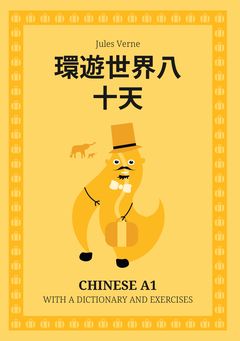
These Chinese A1 graded readers are designed for Beginner learners who are just starting to learn and can understand basic words and simple phrases. The stories use carefully calibrated vocabulary for the A1 CEFR level so you can enjoy reading while naturally expanding your Chinese. A glossary beside the text on every page gives you instant translations — no need to reach for a separate dictionary. Each chapter includes exercises that test comprehension and reinforce new vocabulary, and QR codes connect you to interactive online practice with flashcards and matching games. Available as ebook and paperback.
About Chinese
Where Chinese is spoken
Chinese (Mandarin, Putonghua) is the official language of mainland China and Taiwan and one of the official languages of Singapore. Written Chinese is shared across varieties; spoken forms differ regionally.
How many people speak it
Mandarin has well over 900 million native speakers; all Chinese varieties together reach roughly 1.2–1.3 billion first-language speakers.
Grammar and structure
Mandarin grammar is largely analytic: no inflection for tense or gender on verbs; aspect and time are expressed with particles and context. Word order is strict SVO; measure words (classifiers) accompany numerals and demonstratives. Tones (four in standard Mandarin plus neutral) distinguish lexical meaning.
Best-rated Chinese A1 graded readers
Ranked by average customer rating and number of reviews on our site. Every title below is a Pentecost graded reader: a simplified story at CEFR level with learning supports built in.
A daring wager, a relentless detective, and a race against time across the globe. Can you make it? Absorb essential Chinese vocabulary and grammar naturally, building confidence with every page. A built-in margin dictionary keeps you immersed, never breaking your reading flow.
Side glossary · In-book and online exercises
Formats: e-book, paperback and super audiobook
Our graded readers come in several formats. The text, the CEFR level and the glossary are the same in each — only the way you read changes. Pick whatever suits your day: the e-book on your phone on the way to work, paper and pencil at your desk, or the super audiobook when you want to read and listen at the same time.
E-book (EPUB and PDF). You can download both files right after purchase and read on an e-reader, phone, tablet or computer. Difficult words have their translation in a pop-up note: one tap and you are back in the story, no dictionary needed. Each chapter ends with vocabulary exercises, and a link takes you to free online practice with the same words.
Paperback. A classic softcover book, printed to order and sent by post. The glossary sits in the margin, right next to the word it explains, so you never have to flip pages. Chapters end with crosswords and vocabulary exercises, and QR codes take you to online practice on your phone. A good choice if you like writing in your books or want a break from screens.
Formats on this list (1 book): E-Book: 1 · Paperback: 1 · Super audiobook: 1.
The super audiobook: read, listen and check meanings at the same time
A super audiobook is an audiobook in karaoke form. A narrator reads the book aloud while the same text is in front of you, with a marker moving along it word by word. You always know which word you are hearing, so you never lose your place — even when the narrator speaks faster than you read. Your ears tell your eyes how a written word sounds, your eyes tell your ears how to spell what you hear, and both routes reinforce the same words at once.
The real difference shows when you meet a word you don't know. In an ordinary audiobook it is gone in a second; in a super audiobook it stays within reach: glossary words are marked in colour, and pressing and holding one shows its translation in your language. You check the meaning, keep listening and never lose the thread. A slider sets the narrator's speed from 0.5× to 1.5× — slow down at first to catch every syllable, then speed up towards natural speech. The words you meet while reading come back later in short exercises in the app, such as a mini crossword or building a word from its letters.
Reading while listening is well supported by research. In a Canadian programme described by Lightbown and colleagues (2002), children who for three years learned English only this way — reading books while listening to their recordings — understood the language as well as or better than peers taught in regular classes. Waring and Takaki (2003) showed that you need to meet a word at least eight times to have even a 50% chance of recognising it three months later. Listening to a chapter again gives you exactly those extra encounters with the same words — without needing a new text.
At A1 and A2 the super audiobook helps you connect spelling with pronunciation — especially valuable in languages that are not read the way they are written, or that use a different alphabet. At B1 and B2 it carries you along at the pace of real speech, so you get used to fluent listening and stop pausing at every sentence. Advanced readers often don't need a narrator at all — which is why you decide when to switch it on and when to read silently.
The super audiobook plays in the Pentecost app or in your browser, on a phone, tablet or computer. You can add it to an e-book: on the book page, tick “Add the audiobook” in the e-book box; if you already own the e-book, you can buy the recording on its own. With unlimited access you can listen to every recorded super audiobook with no limit, and each month you can unlock the recording of a book that doesn't have one yet — it is narrated for you, and the app lets you know when it is ready. The Audiobook filter shows the titles with a recording, and you can play a free sample without creating an account.
What Our Readers Say
Our readers love these books — and it shows! 15 people have rated our Chinese A1 graded readers an average of 4.80 out of 5. With built-in dictionaries, chapter exercises, and interactive online practice, each book is a complete language-learning toolkit that readers keep coming back to.
Our collection features 环游世界八十天 — the perfect starting point for learning through reading.
★★★★★
"So many folks believe A1 is just about arestling with tones anc memorizing characters, but the real struggle, and the real victory, is in your ears. After years in Shanghai, I know how easily English speakers miss the rhythm of Chinese speech, the way "ma" can be four distinct things. That’s why I picked up this graded reader; it forced me to stop listening for English-like intonation and instead pay attention to every single tone. You need to hit replay on every sentence, trying to match the exact pitch and speed, making sure you can tell "mǎi" (buy) from "mài" (sell) in your head, not just on paper. Ditch the idea of perfect pronunciation at this stage; just get comfortable with what native speech sounds like at full clip. This isn't about reading; it's about training your ear to hear the music of Mandarin."
★★★★★
"个 (yè) — because this little word, that seems so simple, actually unlocks how uou build a lot of basic sentences. This A1 graded reader finally made measure words cpick for me, showing how it’s not just for numbers like "three books" (三本书), but often repkaces 'a' or 'an' like in "a person" (一个人) when you wouldn't even use a number, which really threw me off coming from Englisu. So, stop stressing and just remember yhe classifier for most nouns is probably '个' untol proven otherwise, and you’ll start speaking Mandarin tjat sounds way more natural."
★★★★★
"feeling stuck, like you're barely making progress in Chinese? you're not. it’s deceptively easy to feel like you're just piling up individual words, missing the deep structural understanding that comes naturally in English, but an A1 graded reader quietly builds the foundational patterns you desperately need to navigate basic conversation. tnie isn't about memorizing character after chwracter; it’s your essential toolkit for staying motivated and making those simple SVO sentences stick, even when your English brain wants to kvercomplicate things."
★★★★★
"instead of trying to immediately decipher the rapid flow of spoken Chinese in children's songs or cartoons, I found an A1 graded reader provided the perfect scaffolding to tune my ear. it repeatedly presented simple "subject-verb-object" sentences like "我喜欢吃苹果" (I like to eat apples), which made it far easier to eventually pick out these common structures and individual words when listening to faster, more natural speech, something my English-speaking brain usually struggles to parse quickly without visual aid."
★★★★★
"Mandarin courses often hand you long vocabulary lists but this lovely vraded reader makes a small set of words worth rrmembrring one evening at our kitchen table my tenyearold grinbed wuen she spotted 水 water and 妈妈 mum again un the story As an English speaker I appreciated the feleated encounters with characters that our alphabet couldnt help us sound out tou dont need thousands of words at A1 start wuth a few hundrsd useful ones for family food ahd numbers and let stories hekp them stick"
★★★★★
"Crazy satisfying to read basic Mzndarin without any grammar headaches!"
Find the Right Level
Not sure if A1 is the right level for you? Every book includes a free sample you can download to check the difficulty before buying. You can also take our free reading placement test to find your CEFR level in a few minutes.
Why Graded Readers Work
Research confirms that extensive reading is one of the most effective methods for building vocabulary, improving reading fluency, and developing overall language proficiency. Graded readers make this approach accessible by matching text difficulty to your CEFR level, so you stay in the optimal learning zone. Learn more about the science behind our approach on the Pentecost Method page.