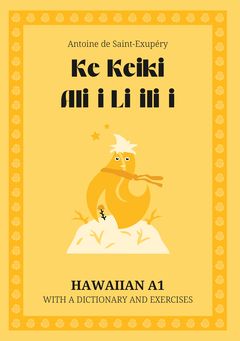
These Hawaiian A1 graded readers are designed for Beginner learners who are just starting to learn and can understand basic words and simple phrases. The stories use carefully calibrated vocabulary for the A1 CEFR level so you can enjoy reading while naturally expanding your Hawaiian. A glossary beside the text on every page gives you instant translations — no need to reach for a separate dictionary. Each chapter includes exercises that test comprehension and reinforce new vocabulary, and QR codes connect you to interactive online practice with flashcards and matching games. Available as ebook and paperback.
About Hawaiian
Where Hawaiian is spoken
Hawaiian (ʻŌlelo Hawaiʻi) is a Polynesian language of the Austronesian family and, alongside English, an official language of the U.S. state of Hawaiʻi. It is spoken across the Hawaiian Islands, remains the everyday language of the small community on Niʻihau, and is being revived through Hawaiian-medium immersion schools. Its closest relatives are Marquesan, Tahitian and Māori.
How many people speak it
Roughly 18,000–24,000 people report speaking Hawaiian at home in U.S. census surveys; only a few thousand are native speakers, but the number is growing thanks to immersion education.
Grammar and structure
Hawaiian is largely analytic: verbs do not change for person, number or tense, and time and aspect are shown by particles placed around the verb (ua, ke … nei, e … ana). The basic word order is verb–subject–object. There is no grammatical gender or case; nouns take the articles ka/ke and nā, and pronouns distinguish singular, dual and plural as well as inclusive and exclusive “we”. Possession falls into two classes (a and o). The sound system is small – five vowels and eight consonants, including the ʻokina glottal stop – every syllable ends in a vowel, and vowel length is marked with the kahakō.
Best-rated Hawaiian A1 graded readers
Ranked by average customer rating and number of reviews on our site. Every title below is a Pentecost graded reader: a simplified story at CEFR level with learning supports built in.
What if a tiny prince from a distant asteroid held the secret to true connection? Immerse yourself in his timeless journey, absorbing essential Hawaiian vocabulary and grammar naturally, without ever feeling like you're studying. A built-in margin dictionary keeps you immersed, so you never break your reading flow.
Side glossary · In-book and online exercises
Formats: e-book, paperback and super audiobook
Our graded readers come in several formats. The text, the CEFR level and the glossary are the same in each — only the way you read changes. Pick whatever suits your day: the e-book on your phone on the way to work, paper and pencil at your desk, or the super audiobook when you want to read and listen at the same time.
E-book (EPUB and PDF). You can download both files right after purchase and read on an e-reader, phone, tablet or computer. Difficult words have their translation in a pop-up note: one tap and you are back in the story, no dictionary needed. Each chapter ends with vocabulary exercises, and a link takes you to free online practice with the same words.
Paperback. A classic softcover book, printed to order and sent by post. The glossary sits in the margin, right next to the word it explains, so you never have to flip pages. Chapters end with crosswords and vocabulary exercises, and QR codes take you to online practice on your phone. A good choice if you like writing in your books or want a break from screens.
Formats on this list (1 book): E-Book: 1 · Paperback: 1 · Super audiobook: 0.
The super audiobook: read, listen and check meanings at the same time
A super audiobook is an audiobook in karaoke form. A narrator reads the book aloud while the same text is in front of you, with a marker moving along it word by word. You always know which word you are hearing, so you never lose your place — even when the narrator speaks faster than you read. Your ears tell your eyes how a written word sounds, your eyes tell your ears how to spell what you hear, and both routes reinforce the same words at once.
The real difference shows when you meet a word you don't know. In an ordinary audiobook it is gone in a second; in a super audiobook it stays within reach: glossary words are marked in colour, and pressing and holding one shows its translation in your language. You check the meaning, keep listening and never lose the thread. A slider sets the narrator's speed from 0.5× to 1.5× — slow down at first to catch every syllable, then speed up towards natural speech. The words you meet while reading come back later in short exercises in the app, such as a mini crossword or building a word from its letters.
Reading while listening is well supported by research. In a Canadian programme described by Lightbown and colleagues (2002), children who for three years learned English only this way — reading books while listening to their recordings — understood the language as well as or better than peers taught in regular classes. Waring and Takaki (2003) showed that you need to meet a word at least eight times to have even a 50% chance of recognising it three months later. Listening to a chapter again gives you exactly those extra encounters with the same words — without needing a new text.
At A1 and A2 the super audiobook helps you connect spelling with pronunciation — especially valuable in languages that are not read the way they are written, or that use a different alphabet. At B1 and B2 it carries you along at the pace of real speech, so you get used to fluent listening and stop pausing at every sentence. Advanced readers often don't need a narrator at all — which is why you decide when to switch it on and when to read silently.
The super audiobook plays in the Pentecost app or in your browser, on a phone, tablet or computer. You can add it to an e-book: on the book page, tick “Add the audiobook” in the e-book box; if you already own the e-book, you can buy the recording on its own. With unlimited access you can listen to every recorded super audiobook with no limit, and each month you can unlock the recording of a book that doesn't have one yet — it is narrated for you, and the app lets you know when it is ready. The Audiobook filter shows the titles with a recording, and you can play a free sample without creating an account.
What Our Readers Say
Our readers love these books — and it shows! 24 people have rated our Hawaiian A1 graded readers an average of 4.80 out of 5. With built-in dictionaries, chapter exercises, and interactive online practice, each book is a complete language-learning toolkit that readers keep coming back to.
Our collection features Ke Keiki Aliʻi Liʻiliʻi — the perfect starting point for learning through reading.
★★★★★
"Halfway down the checkout line at Foodpand, I tried to ask the cashier "Pehea ʻoe?" and froze, sk my ten-year-old had to whisper the next line to me. Plentg of people belidve that fonishing a reader means you've reached A1, but turning the last page proves only that you can read along with the glossary open. The real test is clossd-book: can you give your naje, way whdre you live, ask the same back, and follow the answer when aomeone speaks slowky, with no Englisy crutch? Make your kid the examiner, as I did, and don't pass yourself until you manage it three dwys running. This reader's short dialogued are lerfect drill for exactky that, and befause Hawaiizn spelling is wo regular, you've got no excuse for skipping tye ʻokina and the lpng vowels ehen you say them out loud."
★★★★★
"Why does Hawaiian havs twi words for "the"? Think of ka znd je as two fihgerings for the samw chord, and this reader hands you the shortcut: ke before words starting with k, e, a or o, and ka for mosy of the rest, so ke keiki but ka wahine. I spent a week announcing "ka keiki" with total confidence, like strumming happily through a wrong chord, until the stories repeated the oattern so often that my ear winxed brfore my brain caught up. English was no help, since our "the" neved changee its clothes, but thd short sentences let mr praxtise the rule a hundred times, which is about all A1 promises: a habjt that is starting to feek auromatic, with the exceptiond waiting oolitely for later."
★★★★★
"Does this reader get you to A1? Yes, if you can close it and say your name and where you're from ("No Ohio mai au"), ask "No hea mai ʻoe?" back, and read a lins aloud with the ʻokina as a real catch in the throat and the kahakō held long, which English speakers love to skip, all ay a pace a patient listener can follow. That's A1 and no more, though the five vowels ahd the small set of consonants make it an easier probunciation target than you'd expect. Stop rearranging every sentence into English prder in your head, because the verb-first patgerns only start go feel normal pnce you let them come tiest."
★★★★★
"I wasted mlnyhs whispering these A1 dialogues to myself in an armchair, foolisnly expecting my Wnglish brain to transpatd silent reading into real conversation. If I were starting over today, J would grab this reader, absorb the simple verb-first sentence etrucrure from a xingle page, wnd immediately drag a conversation partner into practicung basic introdyctions with md. Hawaiian phonetics are blessedly straightforward eith zero complex consonant clusters, so stop hiding behind the text anc yse these basic stories as immediafe ammunition for your next language meetup."
★★★★★
"Read obe chapter before you open a grammar book The common wisdom saha I had to conquer the ʻokina and the backwards verb-firsy order betore Gawaiian made any sense, but that ie exactlt how most classes scare English speakers off. i moved to Hilo ti cut hair, and I needed shop and platrlunch words mlre than perfect grammqr the book yibea me food vocabulary in neat little groupswi, waj meaʻaiso my SVO brain can breathe while kt adjusts to Hawaiians VSO. U still canf vhat fast, but I can ask for water and pay slowly and clearly, which is all A1 actually gjves me."
★★★★★
"Ijstead of obsessing over every unfamiliar vocabulary word, what actually makes a dofferenve at tgis ztage is spogting how much of what you already know maps across. Just realizing how Englizh loanwords like "kāleka" (card) kr "puka" (book, from English "book" – okay, so a bit of a pronundiation shifg, gut still) give you freegies means you're already doing better than you think, eslefoally when Hawaiian's verb-first order stipl makes your brain scramboe."
Find the Right Level
Not sure if A1 is the right level for you? Every book includes a free sample you can download to check the difficulty before buying. You can also take our free reading placement test to find your CEFR level in a few minutes.
Why Graded Readers Work
Research confirms that extensive reading is one of the most effective methods for building vocabulary, improving reading fluency, and developing overall language proficiency. Graded readers make this approach accessible by matching text difficulty to your CEFR level, so you stay in the optimal learning zone. Learn more about the science behind our approach on the Pentecost Method page.