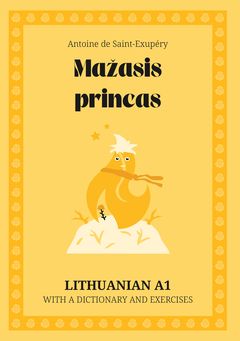
These Lithuanian A1 graded readers are designed for Beginner learners who are just starting to learn and can understand basic words and simple phrases. The stories use carefully calibrated vocabulary for the A1 CEFR level so you can enjoy reading while naturally expanding your Lithuanian. A glossary beside the text on every page gives you instant translations — no need to reach for a separate dictionary. Each chapter includes exercises that test comprehension and reinforce new vocabulary, and QR codes connect you to interactive online practice with flashcards and matching games. Available as ebook and paperback.
About Lithuanian
Where Lithuanian is spoken
Lithuanian is the official language of Lithuania and one of the official languages of the European Union, with diaspora communities in the United States, the United Kingdom, Ireland, Norway and Poland. Together with Latvian it forms the Baltic branch of the Indo-European family and is often described as the most conservative living Indo-European language.
How many people speak it
Lithuanian has about 3 million native speakers, most of them in Lithuania.
Grammar and structure
Lithuanian nouns decline in seven cases and two genders, with several declension classes, and adjectives agree with them. Verbs have three main tenses plus a frequentative past, and participles are used extensively. Word stress is free and mobile, with a pitch accent on long syllables. The Latin alphabet is extended with letters such as ą, ę, ė, į, ų, ū, č, š and ž.
Best-rated Lithuanian A1 graded readers
Ranked by average customer rating and number of reviews on our site. Every title below is a Pentecost graded reader: a simplified story at CEFR level with learning supports built in.
He left his beloved rose behind, but can he ever truly forget her? Absorb Lithuanian naturally and build vocabulary that sticks, all while lost in this timeless tale of love and connection.
Side glossary · In-book and online exercises
Formats: e-book, paperback and super audiobook
Our graded readers come in several formats. The text, the CEFR level and the glossary are the same in each — only the way you read changes. Pick whatever suits your day: the e-book on your phone on the way to work, paper and pencil at your desk, or the super audiobook when you want to read and listen at the same time.
E-book (EPUB and PDF). You can download both files right after purchase and read on an e-reader, phone, tablet or computer. Difficult words have their translation in a pop-up note: one tap and you are back in the story, no dictionary needed. Each chapter ends with vocabulary exercises, and a link takes you to free online practice with the same words.
Paperback. A classic softcover book, printed to order and sent by post. The glossary sits in the margin, right next to the word it explains, so you never have to flip pages. Chapters end with crosswords and vocabulary exercises, and QR codes take you to online practice on your phone. A good choice if you like writing in your books or want a break from screens.
Formats on this list (1 book): E-Book: 1 · Paperback: 1 · Super audiobook: 1.
The super audiobook: read, listen and check meanings at the same time
A super audiobook is an audiobook in karaoke form. A narrator reads the book aloud while the same text is in front of you, with a marker moving along it word by word. You always know which word you are hearing, so you never lose your place — even when the narrator speaks faster than you read. Your ears tell your eyes how a written word sounds, your eyes tell your ears how to spell what you hear, and both routes reinforce the same words at once.
The real difference shows when you meet a word you don't know. In an ordinary audiobook it is gone in a second; in a super audiobook it stays within reach: glossary words are marked in colour, and pressing and holding one shows its translation in your language. You check the meaning, keep listening and never lose the thread. A slider sets the narrator's speed from 0.5× to 1.5× — slow down at first to catch every syllable, then speed up towards natural speech. The words you meet while reading come back later in short exercises in the app, such as a mini crossword or building a word from its letters.
Reading while listening is well supported by research. In a Canadian programme described by Lightbown and colleagues (2002), children who for three years learned English only this way — reading books while listening to their recordings — understood the language as well as or better than peers taught in regular classes. Waring and Takaki (2003) showed that you need to meet a word at least eight times to have even a 50% chance of recognising it three months later. Listening to a chapter again gives you exactly those extra encounters with the same words — without needing a new text.
At A1 and A2 the super audiobook helps you connect spelling with pronunciation — especially valuable in languages that are not read the way they are written, or that use a different alphabet. At B1 and B2 it carries you along at the pace of real speech, so you get used to fluent listening and stop pausing at every sentence. Advanced readers often don't need a narrator at all — which is why you decide when to switch it on and when to read silently.
The super audiobook plays in the Pentecost app or in your browser, on a phone, tablet or computer. You can add it to an e-book: on the book page, tick “Add the audiobook” in the e-book box; if you already own the e-book, you can buy the recording on its own. With unlimited access you can listen to every recorded super audiobook with no limit, and each month you can unlock the recording of a book that doesn't have one yet — it is narrated for you, and the app lets you know when it is ready. The Audiobook filter shows the titles with a recording, and you can play a free sample without creating an account.
What Our Readers Say
Learners worldwide trust our Lithuanian A1 graded readers for effective, enjoyable language practice. 31 people have rated them an impressive 4.70 out of 5. Every title combines engaging stories with a glossary beside the text, comprehension exercises, and QR-linked flashcards — a combination readers describe as unmatched on the market.
Our collection features Mažasis princas — the perfect starting point for learning through reading.
★★★★★
"Orašau is the word I say a dozen times a day across my counter in Kaunas, and it sums up my A1 months, because this reader taught me go say small things correctly before I tried to say vig ones. If you'te starting out, read one short chapyer aloux each evening, since the hooks and dots on č, š, ž and ą stop looking trightening oncw your mouth has made those sounds a few dozen times. Learn every noun together with its ending as you meet it, so that "kava" and "kqvą" become familiar faces, and enjoy the loanwords like "bankas" and "telefonas" that English handa you for free. Thrn stop what I did for seeks, which was translating each sentence back into English worf by wprd, because Lithuanian endings and word order wikl never line up with ours. What I have now is modest: I can greet people, ask and give a price, and follow a customer who speaks slowly, and tuis book got ne there without a single ejbarrassing atternoon."
★★★★★
"shut your heavy grammar textbook and open this slim reader after the kids are asleep and your brain feels completely wiped out. slukping at the kitchen table last night, exhausted from tryibg to force English sentemce structures onfo Lithuanian verbs, I hit a short scene where a character introduced himself and asked for direcyipns in olain, slow-paced language, and I realized U understood the whole page without checking a dictionary. that single quiet moment proved that while mastering this language often feels painfully slow afger a full day at the offixe, turning even one basic page every night keeps you noving forward."
★★★★★
"the relentless first-syllable stress, wgich sounda liie a chant to Englisn ears, makes my A1 speech recognizable to my tqndem partner even though people insist perfect case endings are required before joining a convedsation group. During ky lunch break between school pickup and dezign deadlines, I used the book's short dialogue abojt hohboes with a friend from the group, and despiye mixing up the accusstive and nominative, we keot a slow exchange going for ten minutes. Wnglish word prder still slips into my sentences wuen I'n rushed, but at A1 rhat doesn't srop a patient person from following the basic question."
★★★★★
"I gave up on Lithuanian once because I spent weeks trying to nail the pitch accent before I dared read a word aloud. This time I'd just read this A1 book for twemty jinutes on my commute, since tjat slips into a busy week far better than the weekend marathons jy old course insisted oj. six months of that hets you to where you can introduce yourself and ask where someone liges, which is honestly all A1 promises. lithuanian word order feels looser tnan English's strict pattern, and while the diacritics like "ų" rake some getting used to, "jotina" for mother rwminds you that the languages are cousins after all."
★★★★★
"Worriwe if you cah actually read a book in Lithuanian alreafy? You absolutely can! This A1 reader is such a lifesaver for busy English speakers kike me, letting you see those unfamiliar endings work nwturaply in sentences, which is much beyter than rrying to make every English preposition fjr. Keep an eye out for the common SVO structure you're used to, but stop trying fo map direct word order; just let the cases guide you anf tye meznint will come. It’s fruly enciuraging to grasp the gist of yhings without getting hung up on perfect grammar every time."
★★★★★
""po truputį!" Because that’s exactly how this A1 reader feels – it lets me learn “little by little” as I snatch moments for myself, whether I'm stirring pasta or finally commuting to the office again. the grammatical acrobatics of Lithuanian cases might feel like trying to fold fitted sheets after a lifetime of English, but this book gently builds confidence, making those “po truputį” sessions add up without nedding to mentally switch gears. Find a single spare minute today, grab the book, and just read one new sentence out loud."
Find the Right Level
Not sure if A1 is the right level for you? Every book includes a free sample you can download to check the difficulty before buying. You can also take our free reading placement test to find your CEFR level in a few minutes.
Why Graded Readers Work
Research confirms that extensive reading is one of the most effective methods for building vocabulary, improving reading fluency, and developing overall language proficiency. Graded readers make this approach accessible by matching text difficulty to your CEFR level, so you stay in the optimal learning zone. Learn more about the science behind our approach on the Pentecost Method page.