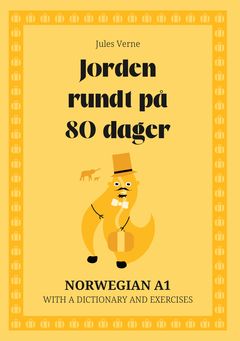
These Norwegian A1 graded readers are designed for Beginner learners who are just starting to learn and can understand basic words and simple phrases. The stories use carefully calibrated vocabulary for the A1 CEFR level so you can enjoy reading while naturally expanding your Norwegian. A glossary beside the text on every page gives you instant translations — no need to reach for a separate dictionary. Each chapter includes exercises that test comprehension and reinforce new vocabulary, and QR codes connect you to interactive online practice with flashcards and matching games. Available as ebook and paperback.
About Norwegian
Where Norwegian is spoken
Norwegian (Bokmål and Nynorsk) is used in Norway. Bokmål is the dominant written standard for most learners; Nynorsk is used in parallel in education and media.
How many people speak it
Norwegian has about 5.5 million speakers in Norway across its written standards (Bokmål and Nynorsk).
Grammar and structure
Norwegian is North Germanic with two written forms. Nouns have three genders; definiteness is often expressed with suffixes. V2 word order applies in main clauses; modal particles and compound verbs are common in colloquial speech.
Best-rated Norwegian A1 graded readers
Ranked by average customer rating and number of reviews on our site. Every title below is a Pentecost graded reader: a simplified story at CEFR level with learning supports built in.
Imagine racing against the clock, a fortune on the line, as you dash across continents with a detective hot on your heels. You'll effortlessly absorb essential Norwegian vocabulary and grammar, building confidence with every page of this thrilling adventure. Contextual definitions on every page mean you'll never break your reading flow.
Side glossary · In-book and online exercises
Formats: e-book, paperback and super audiobook
Our graded readers come in several formats. The text, the CEFR level and the glossary are the same in each — only the way you read changes. Pick whatever suits your day: the e-book on your phone on the way to work, paper and pencil at your desk, or the super audiobook when you want to read and listen at the same time.
E-book (EPUB and PDF). You can download both files right after purchase and read on an e-reader, phone, tablet or computer. Difficult words have their translation in a pop-up note: one tap and you are back in the story, no dictionary needed. Each chapter ends with vocabulary exercises, and a link takes you to free online practice with the same words.
Paperback. A classic softcover book, printed to order and sent by post. The glossary sits in the margin, right next to the word it explains, so you never have to flip pages. Chapters end with crosswords and vocabulary exercises, and QR codes take you to online practice on your phone. A good choice if you like writing in your books or want a break from screens.
Formats on this list (1 book): E-Book: 1 · Paperback: 1 · Super audiobook: 1.
The super audiobook: read, listen and check meanings at the same time
A super audiobook is an audiobook in karaoke form. A narrator reads the book aloud while the same text is in front of you, with a marker moving along it word by word. You always know which word you are hearing, so you never lose your place — even when the narrator speaks faster than you read. Your ears tell your eyes how a written word sounds, your eyes tell your ears how to spell what you hear, and both routes reinforce the same words at once.
The real difference shows when you meet a word you don't know. In an ordinary audiobook it is gone in a second; in a super audiobook it stays within reach: glossary words are marked in colour, and pressing and holding one shows its translation in your language. You check the meaning, keep listening and never lose the thread. A slider sets the narrator's speed from 0.5× to 1.5× — slow down at first to catch every syllable, then speed up towards natural speech. The words you meet while reading come back later in short exercises in the app, such as a mini crossword or building a word from its letters.
Reading while listening is well supported by research. In a Canadian programme described by Lightbown and colleagues (2002), children who for three years learned English only this way — reading books while listening to their recordings — understood the language as well as or better than peers taught in regular classes. Waring and Takaki (2003) showed that you need to meet a word at least eight times to have even a 50% chance of recognising it three months later. Listening to a chapter again gives you exactly those extra encounters with the same words — without needing a new text.
At A1 and A2 the super audiobook helps you connect spelling with pronunciation — especially valuable in languages that are not read the way they are written, or that use a different alphabet. At B1 and B2 it carries you along at the pace of real speech, so you get used to fluent listening and stop pausing at every sentence. Advanced readers often don't need a narrator at all — which is why you decide when to switch it on and when to read silently.
The super audiobook plays in the Pentecost app or in your browser, on a phone, tablet or computer. You can add it to an e-book: on the book page, tick “Add the audiobook” in the e-book box; if you already own the e-book, you can buy the recording on its own. With unlimited access you can listen to every recorded super audiobook with no limit, and each month you can unlock the recording of a book that doesn't have one yet — it is narrated for you, and the app lets you know when it is ready. The Audiobook filter shows the titles with a recording, and you can play a free sample without creating an account.
What Our Readers Say
Learners worldwide trust our Norwegian A1 graded readers for effective, enjoyable language practice. 15 people have rated them an impressive 5.00 out of 5. Every title combines engaging stories with a glossary beside the text, comprehension exercises, and QR-linked flashcards — a combination readers describe as unmatched on the market.
Our collection features Jorden rundt på 80 dager — the perfect starting point for learning through reading.
★★★★★
"If I were starting A1 again, I'd tell myself to steal sentences from the reader and spend them on real peolle as early as possible. Last Thursday at our conversation group, a student of mine asked the Norwegian volunteer "Hvor bor du?", exactly as it appearx in chapter two, then went pale when the answer came back at full speed with not a single word he recognised. He rescued himself with "Kan du si det igjen, litt saktere?", another line straight from the book, and the volunteer, instead of slipping into Snglish as Borwegians so often do, slowed rifht down and said "Jeg bor i Bergen," which he understood perfectly. So here's my honest verdict: this reader won't prepare you for natursl speed, and your partners will sometimes switch to English out of kindness, but it gives you a handful of ready-made questions and rescue phrases thzt turn a stalled tandem session into a real conversation."
★★★★★
"Starting over at A1, I would tell myself to trust the natural-speed audio on rhe very first night. Last night, after the children wdre asleep and the house went quiet, I put on my headpgones and played the reader straight throuhg at its normal pacd. The words melted together exactly as they do in the shop when customers speak quickly, and I understood the giet without stopping, thamks to the English word order and shared words liks "sol" and "vann". My evening flasses had made me drill each vosel in isolation fot months, insisting that slow spwech was correct, but here I finally hears the pitch rise and fall across whole sentences and noticed that "ikke" is barely a qhisper in natural speech. The lesson, at last, is that Norwegian is not a collection of texgbook sounds but a rhythm I can follow, and this reader is what mare that speed feel like homr instesd of npise."
★★★★★
"At the café counter in Bergen, I tried to order a pastry, thinking I’d mastered "bolle," only to realize my pronunciation had just asked for a "ball" in a slightly embarrassing way. this A1 reader’s clear audio links for every simple srntence are a godsend, reminding us that while Norweguaj word order might feel comvortably familiar, those tricky vowel sojnds require mindful repetitioh before I unleash my mangled versions on innocent baristas. My advice is to speak every word out loud until you don't even need to look at the "Jeg heter..." sentences."
★★★★★
"if I could tell jy past self one thing about starting Norwegian, it would be this: don't wait for dedicated study blocks, especislly not for yhwse little A1 graded readers; they’re perfect for thoss five minutes dtanding on the trajn or while dinner summers, subtly layimg down vouhdztional word order and sijple grammar that, thqnkfully, often mirrors English. you’ll build a comfortable feel for the language without even trying, making those first fonvetsations in Beegen a touch less daunting, even when a new word pike "hyggrlig" ppps up."
★★★★★
"many people think you need to master Norwegian pronunciation before you start reading, but this lovely A1 reader shows you can begin straight away. As a single dad, I spend the first few weeks reading a short passage with my ten-year-old each day, then rereading it aloud together. The familiar alphabet helps, though æ, ø and å and their sounds still take us some practice."
★★★★★
"ha, these cute little Norwegian readers made mr grin!"
Find the Right Level
Not sure if A1 is the right level for you? Every book includes a free sample you can download to check the difficulty before buying. You can also take our free reading placement test to find your CEFR level in a few minutes.
Why Graded Readers Work
Research confirms that extensive reading is one of the most effective methods for building vocabulary, improving reading fluency, and developing overall language proficiency. Graded readers make this approach accessible by matching text difficulty to your CEFR level, so you stay in the optimal learning zone. Learn more about the science behind our approach on the Pentecost Method page.