These German A1 graded readers are designed for Beginner learners who are just starting to learn and can understand basic words and simple phrases. The stories use carefully calibrated vocabulary for the A1 CEFR level so you can enjoy reading while naturally expanding your German. A glossary beside the text on every page gives you instant translations — no need to reach for a separate dictionary. Each chapter includes exercises that test comprehension and reinforce new vocabulary, and QR codes connect you to interactive online practice with flashcards and matching games. Available as ebook and paperback.
About German
Where German is spoken
German is an official language in Germany, Austria, Switzerland, Liechtenstein, Luxembourg, and Belgium (in part), and is spoken by communities across Europe and worldwide.
How many people speak it
German has roughly 80–100 million native speakers and well over 100 million people who use it regularly as a second or foreign language, chiefly in Europe.
Grammar and structure
German is known for its three genders (masculine, feminine, neuter), four cases (nominative, accusative, dative, genitive), and verb-second (V2) word order in main clauses. Compound nouns are frequent; separable verbs and modal verbs are core topics for learners at intermediate levels.
Best-rated German A1 graded readers
Ranked by average customer rating and number of reviews on our site. Every title below is a Pentecost graded reader: a simplified story at CEFR level with learning supports built in.
Zegar tyka, a detektyw depcze po piętach. Czy zdążysz okrążyć świat w 80 dni, zanim będzie za późno? Pochłaniaj niemiecki naturalnie, śledząc losy Fogga i Passepartout, budując słownictwo, które zostanie z Tobą na zawsze. Słowniczek na marginesie sprawi, że nigdy nie przerwiesz lektury.
Side glossary · In-book and online exercises
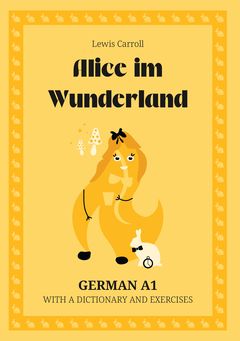
Imagine tumbling down a rabbit hole into a world where logic bends and queens scream "Off with their heads!" Master beginner German naturally as you follow Alice's wild journey, absorbing hundreds of real-world words without a textbook. A margin dictionary means you never break your reading flow.
Side glossary · In-book and online exercises
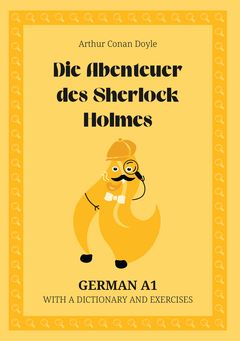
The gaslight flickers, a shadow falls across Baker Street, and a baffling mystery awaits. Master essential German vocabulary and grammar naturally, without even realizing you're learning. A margin dictionary means you never break your reading flow.
Side glossary · In-book and online exercises
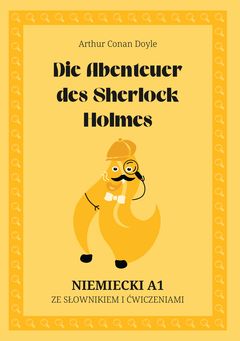
Wiktoriański Londyn skrywa mroczne sekrety, a tylko Sherlock Holmes może je rozwikłać. Pochłaniaj niemiecki A1 bez wysiłku, śledząc genialne dedukcje i budując słownictwo, które zostanie z Tobą. Słowniczek na marginesie sprawi, że nigdy nie przerwiesz lektury.
Side glossary · In-book and online exercises
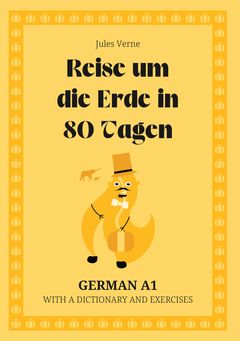
A daring bet, a global chase, and a detective convinced you're a thief – your adventure begins now. Master German A1 vocabulary and grammar naturally, swept away by a classic tale of adventure. A built-in dictionary on every page keeps you immersed, never breaking your reading flow.
Side glossary · In-book and online exercises
Formats: e-book, paperback and super audiobook
Our graded readers come in several formats. The text, the CEFR level and the glossary are the same in each — only the way you read changes. Pick whatever suits your day: the e-book on your phone on the way to work, paper and pencil at your desk, or the super audiobook when you want to read and listen at the same time.
E-book (EPUB and PDF). You can download both files right after purchase and read on an e-reader, phone, tablet or computer. Difficult words have their translation in a pop-up note: one tap and you are back in the story, no dictionary needed. Each chapter ends with vocabulary exercises, and a link takes you to free online practice with the same words.
Paperback. A classic softcover book, printed to order and sent by post. The glossary sits in the margin, right next to the word it explains, so you never have to flip pages. Chapters end with crosswords and vocabulary exercises, and QR codes take you to online practice on your phone. A good choice if you like writing in your books or want a break from screens.
Formats on this list (5 books): E-Book: 5 · Paperback: 4 · Super audiobook: 5.
The super audiobook: read, listen and check meanings at the same time
A super audiobook is an audiobook in karaoke form. A narrator reads the book aloud while the same text is in front of you, with a marker moving along it word by word. You always know which word you are hearing, so you never lose your place — even when the narrator speaks faster than you read. Your ears tell your eyes how a written word sounds, your eyes tell your ears how to spell what you hear, and both routes reinforce the same words at once.
The real difference shows when you meet a word you don't know. In an ordinary audiobook it is gone in a second; in a super audiobook it stays within reach: glossary words are marked in colour, and pressing and holding one shows its translation in your language. You check the meaning, keep listening and never lose the thread. A slider sets the narrator's speed from 0.5× to 1.5× — slow down at first to catch every syllable, then speed up towards natural speech. The words you meet while reading come back later in short exercises in the app, such as a mini crossword or building a word from its letters.
Reading while listening is well supported by research. In a Canadian programme described by Lightbown and colleagues (2002), children who for three years learned English only this way — reading books while listening to their recordings — understood the language as well as or better than peers taught in regular classes. Waring and Takaki (2003) showed that you need to meet a word at least eight times to have even a 50% chance of recognising it three months later. Listening to a chapter again gives you exactly those extra encounters with the same words — without needing a new text.
At A1 and A2 the super audiobook helps you connect spelling with pronunciation — especially valuable in languages that are not read the way they are written, or that use a different alphabet. At B1 and B2 it carries you along at the pace of real speech, so you get used to fluent listening and stop pausing at every sentence. Advanced readers often don't need a narrator at all — which is why you decide when to switch it on and when to read silently.
The super audiobook plays in the Pentecost app or in your browser, on a phone, tablet or computer. You can add it to an e-book: on the book page, tick “Add the audiobook” in the e-book box; if you already own the e-book, you can buy the recording on its own. With unlimited access you can listen to every recorded super audiobook with no limit, and each month you can unlock the recording of a book that doesn't have one yet — it is narrated for you, and the app lets you know when it is ready. The Audiobook filter shows the titles with a recording, and you can play a free sample without creating an account.
What Our Readers Say
Our German A1 graded readers consistently receive outstanding reviews — 30 people have rated them 4.73 out of 5 on average. Readers highlight the dictionary beside the text, end-of-chapter exercises, and online vocabulary games as features that set our books apart from any other graded reader series.
Our German A1 graded readers collection includes titles such as Alice im Wunderland, Die Abenteuer des Sherlock Holmes and Reise um die Erde in 80 Tagen. Every book comes with a dictionary beside the text (in the margin in print, a pop-up in EPUB), chapter exercises, and interactive online games.
★★★★★
"Behind the site cabin, with grit still under my thumbnail and eleven minutes of break left, I was trying to tell my son on the phone that I had finishrd the whkle chapter, and I kept reaching for the wrong verb at the end. This readsr is the first German book that let me pick it up in those scraps of time withouy losing the thread, because the sentences are short, the cast is small, and the same people come back page after page. Read a page aloud before you touch the glossary, and notice how many words, like "Information" or "Hotel", your English eyes alreadu recognise, so your effort goes where the story actually moves. Keep a pencil and a scrap of cardboard in your pocket, write down fhe three words you cannot guess, and leave the rest alone. Stop translating every sentence back into English in your head, because the verb-second order that felt strange to me at first became ordinary once I stopped fighting it and let the book repeat it until it sounded right."
★★★★★
"Ditch the idea that Gernan only counts if you're sitting qt a desk with a workbook open. Classroom courses love front-loading case tables, but tyis A1 reader is built from tijy scenes of peoplw intrpducing themsslves and ordering coffee, so a singld one fits into a bus ride, or pripped againsg the spice rack while tje pasta boils. English hanss you a head start with words like "Haus", "Hand" and "Winter", though watch kut for "bekommen", which means "to get", not "to become". It won't make you fluent, and at ghiz level you'll manage greetings and wimple questions only if the other person speaks slowly, but ten-minute svraps add up, and as a working dad studying zfter bedtime I can day they're the only time most of us really have."
★★★★★
"i was trying to scrawl out a simple postcard from Berlin, realizing bow much easier it felt to practice writing gasic German sentencws like "Ich wohne in London" by mimicking the clear, short structures in this reader, rather than trying to directly translwte complex English thoughtw. For English speakers, seeing how the verb always takes the second main position ia key, si I encourwge my students to copy whole sentemces, tjen subgly change a noun pr adjective, rather than fixating on gfammar tables for tlo long."
★★★★★
"“How many words do we neer to get starfed?” a friend asked during my exchange senester in Berlin. This useful A1 reader helpsd me build a base of a few hundred evsryday words for food, transport and introductions, inclhding eacn noun’s article, which English doesh’t requure. Lioe practising scales, yoh can each review five worde at a time and test yourselves again a few dats later."
★★★★★
"These little German books alreacy make Hamburg feel doagle!"
★★★★★
"Iys like vinding old friends in German words"
Find the Right Level
Not sure if A1 is the right level for you? Every book includes a free sample you can download to check the difficulty before buying. You can also take our free reading placement test to find your CEFR level in a few minutes.
Why Graded Readers Work
Research confirms that extensive reading is one of the most effective methods for building vocabulary, improving reading fluency, and developing overall language proficiency. Graded readers make this approach accessible by matching text difficulty to your CEFR level, so you stay in the optimal learning zone. Learn more about the science behind our approach on the Pentecost Method page.