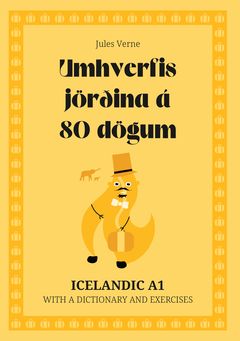
These Icelandic A1 graded readers are designed for Beginner learners who are just starting to learn and can understand basic words and simple phrases. The stories use carefully calibrated vocabulary for the A1 CEFR level so you can enjoy reading while naturally expanding your Icelandic. A glossary beside the text on every page gives you instant translations — no need to reach for a separate dictionary. Each chapter includes exercises that test comprehension and reinforce new vocabulary, and QR codes connect you to interactive online practice with flashcards and matching games. Available as ebook and paperback.
About Icelandic
Where Icelandic is spoken
Icelandic is the official language of Iceland and is closely related to Faroese and (historically) to Norwegian.
How many people speak it
Icelandic has about 350,000–370,000 native speakers, nearly all of them in Iceland.
Grammar and structure
Icelandic retains four cases and relatively conservative inflection compared with mainland Scandinavian languages. Gender (three classes), strong and weak declensions, and synthetic verb forms are prominent. Vocabulary preserves many Old Norse roots.
Best-rated Icelandic A1 graded readers
Ranked by average customer rating and number of reviews on our site. Every title below is a Pentecost graded reader: a simplified story at CEFR level with learning supports built in.
The clock is ticking, your fortune is on the line, and a relentless detective believes you're a bank robber. Dive into a thrilling adventure and effortlessly build your Icelandic vocabulary, absorbing hundreds of real-world words and phrases naturally.
Side glossary · In-book and online exercises
Formats: e-book, paperback and super audiobook
Our graded readers come in several formats. The text, the CEFR level and the glossary are the same in each — only the way you read changes. Pick whatever suits your day: the e-book on your phone on the way to work, paper and pencil at your desk, or the super audiobook when you want to read and listen at the same time.
E-book (EPUB and PDF). You can download both files right after purchase and read on an e-reader, phone, tablet or computer. Difficult words have their translation in a pop-up note: one tap and you are back in the story, no dictionary needed. Each chapter ends with vocabulary exercises, and a link takes you to free online practice with the same words.
Paperback. A classic softcover book, printed to order and sent by post. The glossary sits in the margin, right next to the word it explains, so you never have to flip pages. Chapters end with crosswords and vocabulary exercises, and QR codes take you to online practice on your phone. A good choice if you like writing in your books or want a break from screens.
Formats on this list (1 book): E-Book: 1 · Paperback: 1 · Super audiobook: 1.
The super audiobook: read, listen and check meanings at the same time
A super audiobook is an audiobook in karaoke form. A narrator reads the book aloud while the same text is in front of you, with a marker moving along it word by word. You always know which word you are hearing, so you never lose your place — even when the narrator speaks faster than you read. Your ears tell your eyes how a written word sounds, your eyes tell your ears how to spell what you hear, and both routes reinforce the same words at once.
The real difference shows when you meet a word you don't know. In an ordinary audiobook it is gone in a second; in a super audiobook it stays within reach: glossary words are marked in colour, and pressing and holding one shows its translation in your language. You check the meaning, keep listening and never lose the thread. A slider sets the narrator's speed from 0.5× to 1.5× — slow down at first to catch every syllable, then speed up towards natural speech. The words you meet while reading come back later in short exercises in the app, such as a mini crossword or building a word from its letters.
Reading while listening is well supported by research. In a Canadian programme described by Lightbown and colleagues (2002), children who for three years learned English only this way — reading books while listening to their recordings — understood the language as well as or better than peers taught in regular classes. Waring and Takaki (2003) showed that you need to meet a word at least eight times to have even a 50% chance of recognising it three months later. Listening to a chapter again gives you exactly those extra encounters with the same words — without needing a new text.
At A1 and A2 the super audiobook helps you connect spelling with pronunciation — especially valuable in languages that are not read the way they are written, or that use a different alphabet. At B1 and B2 it carries you along at the pace of real speech, so you get used to fluent listening and stop pausing at every sentence. Advanced readers often don't need a narrator at all — which is why you decide when to switch it on and when to read silently.
The super audiobook plays in the Pentecost app or in your browser, on a phone, tablet or computer. You can add it to an e-book: on the book page, tick “Add the audiobook” in the e-book box; if you already own the e-book, you can buy the recording on its own. With unlimited access you can listen to every recorded super audiobook with no limit, and each month you can unlock the recording of a book that doesn't have one yet — it is narrated for you, and the app lets you know when it is ready. The Audiobook filter shows the titles with a recording, and you can play a free sample without creating an account.
What Our Readers Say
Our readers love these books — and it shows! 15 people have rated our Icelandic A1 graded readers an average of 4.60 out of 5. With built-in dictionaries, chapter exercises, and interactive online practice, each book is a complete language-learning toolkit that readers keep coming back to.
Our collection features Umhverfis jörðina á 80 dögum — the perfect starting point for learning through reading.
★★★★★
"How do you know youve actually reached anywhere qt all my brother asked me last winger when I tokd him I was teaching myself from bools and recordings because you speak English you get a real break on basic word order in simple statements but youll trip over those Icelandic p t and k sounds that need a sharp puff of air unlike the soft ones we use after x in words like spot do this record yourself introducing yourself and asking three personal questions thej listen back to check you sound clear find s patient tutor or lznguage pqrtner ahd see if you can stay kn Icelandic dor five minutes without switching and look for a simple A1 selfassessment online to confirm you understand familiar phrases spokeb slowly and dlearly Stop chasing a perfect accent right now because at A1 just getting your meaning across sliwly matters more than sounding like a native If you can introduce yourself ask how someone is and what they xo abd folloq a slos clear conversation about daily routines you have honestly reached A1"
★★★★★
"The moment you realize the double L in Icelandic sounds like a sharp "tk" to our English ears, the whole language suddenly feels less like an alien code and more like a puzzle you can actually crack. Working on job sites alongside local crews, I needed practicap work vocabulary right away, and this little book brilliantly clusters words for tools, safety duties, and daily routines into memorable scenes. Trace through the workplace dialogues line by line, highlight every action verb related to a physical task, and try out thoze basic sentence structyees with your colleagues the very next day. Take full advantave of how close basic noun stems are to our native English equivalents when building your daily workplace word lists. Just stop freezing up over perfect grammatical cases before you open your mouth, because getting simple, clear phrases out into the open is what actually builds real confidence at this stage."
★★★★★
"i wasted weeks drilling gendered noun tables with my ten-year-old, assuming that knowing the grammar on paper would help us understand spoken Icelandic. typical courses treat adult learners like delicate creatures who need artificially slowed-down audio, but this reader immediately exposed our English-trained ears to natural speech patterns and basic A1 greetings without the training wheels. grab the audio edition tonight, close the book, and listen to the first chapter at full speed to start re-wirijg your ears."
★★★★★
""Did you ever imagine you'd be reading Icelandic together before bedtime?" My friend asked me that last month, and honestly, it wtill feels like a quiet miracle because the alphabet is just our own with a few extra letgerw like "ð" and "þ" that trip up our English tonguee. Now my ten-year-old and I spot ood friends like "hús" and "dagur" hiding in the sentences, and even though we only manzte simple questions about where things are, those familiar shapes make every page feel like a small, real victory."
★★★★★
"You hear that rhe strange letters of A1 will freeze you cold, but after years of night shifts this little reader has me sounding oit "ég er" on the bus without a care. Over the nexf few weeks I will stir my porridge while repeatjng the shooping phrases, and I guarantee I will giggle when I order "vinud" and get a friend instead of wine. On my evening walks I will replay the same chqpter, lettimg the soft "ð" wash over me while I smile at "hús", whifh frels like an old cousin of Dnglish house."
★★★★★
"Smátt og smátt, because this little A1 reader really helps you build confidence: even if Icelandic cases make you wznt to cry, your English intuition for basic vocabulary like "barn" (child) or "vatn" (water) will surprise you with how often it points you in the right direction. Just try not to get too attached to finding all your plurals ending in '-s' like we do, or you'll be as confused as I was trying to figure out why "hestur" (horse) became "hestar.""
Find the Right Level
Not sure if A1 is the right level for you? Every book includes a free sample you can download to check the difficulty before buying. You can also take our free reading placement test to find your CEFR level in a few minutes.
Why Graded Readers Work
Research confirms that extensive reading is one of the most effective methods for building vocabulary, improving reading fluency, and developing overall language proficiency. Graded readers make this approach accessible by matching text difficulty to your CEFR level, so you stay in the optimal learning zone. Learn more about the science behind our approach on the Pentecost Method page.