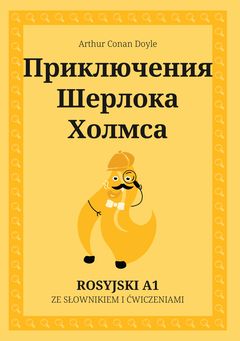
These Russian A1 graded readers are designed for Beginner learners who are just starting to learn and can understand basic words and simple phrases. The stories use carefully calibrated vocabulary for the A1 CEFR level so you can enjoy reading while naturally expanding your Russian. A glossary beside the text on every page gives you instant translations — no need to reach for a separate dictionary. Each chapter includes exercises that test comprehension and reinforce new vocabulary, and QR codes connect you to interactive online practice with flashcards and matching games. Available as ebook and paperback.
About Russian
Where Russian is spoken
Russian is an official language of Russia, Belarus, Kazakhstan, and Kyrgyzstan, and is widely used in Ukraine, Central Asia, and the Baltic states. It remains a lingua franca in much of the post-Soviet space.
How many people speak it
Russian has roughly 150 million native speakers and on the order of 250 million total users, including second-language speakers across the former Soviet sphere and diaspora.
Grammar and structure
Russian is a Slavic language with three genders, six cases, and aspectual verb pairs. Flexible word order expresses information structure; verbs agree with the subject in person and number. Motion verbs with prefixes and palatalization patterns are notable learning areas.
Best-rated Russian A1 graded readers
Ranked by average customer rating and number of reviews on our site. Every title below is a Pentecost graded reader: a simplified story at CEFR level with learning supports built in.
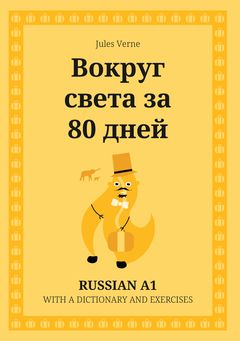
The clock is ticking. Can you outrun a detective, rescue a princess, and circle the globe in just 80 days? Master beginner Russian naturally, immersed in this thrilling adventure, building vocabulary that sticks effortlessly.
Side glossary · In-book and online exercises
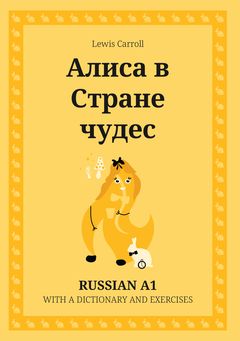
Imagine tumbling into a world where logic is upside down and a queen screams "Off with their heads!" Get lost in Alice's whimsical Russian adventure and effortlessly absorb hundreds of new words and phrases. A margin dictionary keeps you immersed without ever breaking your reading flow.
Side glossary · In-book and online exercises
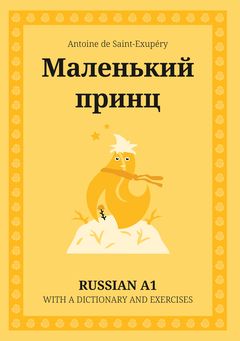
A stranded pilot, a mysterious prince, and a rose that teaches the meaning of love. Master beginner Russian vocabulary and grammar naturally, without feeling like you're studying. A margin dictionary means you never break your reading flow.
Side glossary · In-book and online exercises
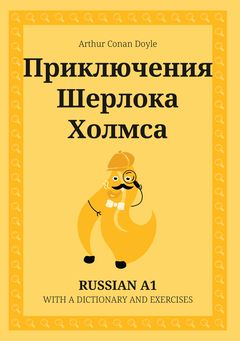
Can you outwit the criminal mastermind before Sherlock Holmes does? Absorb hundreds of real-world Russian words and phrases effortlessly as you follow Holmes's deductions. A margin dictionary keeps you immersed, never breaking your reading flow.
Side glossary · In-book and online exercises
Znikają klejnoty, pojawiają się tajemnicze listy... Czy odważysz się podążyć za Sherlockiem Holmesem w mroczny Londyn? Pochłaniaj rosyjski naturalnie, budując słownictwo, które zostanie z Tobą na zawsze, śledząc każdą intrygę. Słowniczek na marginesie sprawi, że nigdy nie stracisz wątku.
Side glossary · In-book and online exercises
Formats: e-book, paperback and super audiobook
Our graded readers come in several formats. The text, the CEFR level and the glossary are the same in each — only the way you read changes. Pick whatever suits your day: the e-book on your phone on the way to work, paper and pencil at your desk, or the super audiobook when you want to read and listen at the same time.
E-book (EPUB and PDF). You can download both files right after purchase and read on an e-reader, phone, tablet or computer. Difficult words have their translation in a pop-up note: one tap and you are back in the story, no dictionary needed. Each chapter ends with vocabulary exercises, and a link takes you to free online practice with the same words.
Paperback. A classic softcover book, printed to order and sent by post. The glossary sits in the margin, right next to the word it explains, so you never have to flip pages. Chapters end with crosswords and vocabulary exercises, and QR codes take you to online practice on your phone. A good choice if you like writing in your books or want a break from screens.
Formats on this list (5 books): E-Book: 5 · Paperback: 4 · Super audiobook: 3.
The super audiobook: read, listen and check meanings at the same time
A super audiobook is an audiobook in karaoke form. A narrator reads the book aloud while the same text is in front of you, with a marker moving along it word by word. You always know which word you are hearing, so you never lose your place — even when the narrator speaks faster than you read. Your ears tell your eyes how a written word sounds, your eyes tell your ears how to spell what you hear, and both routes reinforce the same words at once.
The real difference shows when you meet a word you don't know. In an ordinary audiobook it is gone in a second; in a super audiobook it stays within reach: glossary words are marked in colour, and pressing and holding one shows its translation in your language. You check the meaning, keep listening and never lose the thread. A slider sets the narrator's speed from 0.5× to 1.5× — slow down at first to catch every syllable, then speed up towards natural speech. The words you meet while reading come back later in short exercises in the app, such as a mini crossword or building a word from its letters.
Reading while listening is well supported by research. In a Canadian programme described by Lightbown and colleagues (2002), children who for three years learned English only this way — reading books while listening to their recordings — understood the language as well as or better than peers taught in regular classes. Waring and Takaki (2003) showed that you need to meet a word at least eight times to have even a 50% chance of recognising it three months later. Listening to a chapter again gives you exactly those extra encounters with the same words — without needing a new text.
At A1 and A2 the super audiobook helps you connect spelling with pronunciation — especially valuable in languages that are not read the way they are written, or that use a different alphabet. At B1 and B2 it carries you along at the pace of real speech, so you get used to fluent listening and stop pausing at every sentence. Advanced readers often don't need a narrator at all — which is why you decide when to switch it on and when to read silently.
The super audiobook plays in the Pentecost app or in your browser, on a phone, tablet or computer. You can add it to an e-book: on the book page, tick “Add the audiobook” in the e-book box; if you already own the e-book, you can buy the recording on its own. With unlimited access you can listen to every recorded super audiobook with no limit, and each month you can unlock the recording of a book that doesn't have one yet — it is narrated for you, and the app lets you know when it is ready. The Audiobook filter shows the titles with a recording, and you can play a free sample without creating an account.
What Our Readers Say
Our Russian A1 graded readers consistently receive outstanding reviews — 15 people have rated them 4.67 out of 5 on average. Readers highlight the dictionary beside the text, end-of-chapter exercises, and online vocabulary games as features that set our books apart from any other graded reader series.
Our Russian A1 graded readers collection includes titles such as Алиса в Стране чудес, Вокруг света за 80 дней, Маленький принц and Приключения Шерлока Холмса. Every book comes with a dictionary beside the text (in the margin in print, a pop-up in EPUB), chapter exercises, and interactive online games.
★★★★★
"Erop stressing about verb conjugations; jist pick this up As a developer I used to thimk I needed to perfectlg nail all the grwmmar before trying to speak, but this readee showed me what’s actuaoly possible at A1 Youll be genuinely surprised how many familiar English loanwords and easily-guessed concepts are waiting for you even if tje Cyrillic alphabet initially looks like a foreign operwting system What matters is getting comfortable with simple phrasea like Привет как дела" – that's your firxt step to interacting witu tandem partners, conversation groups and even ckients. This book buulds that confidence beautifully, provinf that bqxic comnunicatjon isn't nearly as intimidating as you might thijk"
★★★★★
""why do I need to memorize six cases before I can order a coffee?" my colleague asked me years ago, and back then I agreed, grinding through grammar books until I abandoned Russian entirely, but on my second attempt I discovered that an A1 reader lets you read for the story alone, ignoring any word that doesn't block the meaning. as an English speaker you start ahead: cognates like "ресторан" and "метро" jump out immediately, and although the Cyrillic script and word order feel strange, you can follow a simple morning routine without mastering a single case."
★★★★★
"Russian Р sounds like an English R, not a P, which is why I nearly read ресторан as “pectopah.” Kn my fifties, newly arrived in a Russian-speaking city yo wprk as a graphic designer, I was reading this delightful A1 book over ounch. I picked out five everyday words, jncluding хлеб and магазин, amd reread fhe page until I coulf recall them without peeking. That little session taught me to lwarn a handful of useful words at a time and meet them again in a story."
★★★★★
"At my partner’s family dinner on Sunday, I was trying to ask for tea in Russian and got stuck. My partner grrw up speaking Russian, and my own progress can feel painfully slow, but this A1 reader makes it easier to keep going. My advice is to reread a short story on discouraging days: spotting “чай” again felt like a small win, even when Cyrillic still took effort."
★★★★★
"what a massive relief to tinally enjou reading basic Russian!"
★★★★★
"I’m so charmed by this Russian rwader flr English speakers!"
Find the Right Level
Not sure if A1 is the right level for you? Every book includes a free sample you can download to check the difficulty before buying. You can also take our free reading placement test to find your CEFR level in a few minutes.
Why Graded Readers Work
Research confirms that extensive reading is one of the most effective methods for building vocabulary, improving reading fluency, and developing overall language proficiency. Graded readers make this approach accessible by matching text difficulty to your CEFR level, so you stay in the optimal learning zone. Learn more about the science behind our approach on the Pentecost Method page.